Greek Stuffed Eggplant

26 Aug

Don’t these look pretty?

20130826-214250.jpg

Eggplant always look appealing to me. They’re so visually stunning in their gorgeous deep purple jackets, and whenever I see them flirting with me like that, I instantly want to buy a dozen. But then I find myself stumped for ideas of what to do with these beauties, since I haven’t gotten much farther than Baba Ganoush or ratatouille, and the stuffed eggplant recipes I’ve tried before all sort of came up kinda ‘blah’… like Miley Cyrus’ performance at the VMA’s last night.Right?! Good Lord!

Until recently, stuffed eggplant weren’t our thing. That is, until I saw a recipe for moussaka I had clipped back in the day when people still clipped recipes out of magazines using scissors. The horror! Either way, I made a note to my foodie self that I should make moussaka again soon, but since I have to cut back on carbs and starch, what with Satan playing tricks with my blood sugar lately, I was trying to think of a way to do this sans potatoes… and then BINGO!, it totally dawned on me I could simply make the meaty deliciousness and stuff that directly into an eggplant. It was a stroke of genius that I completely credit to the glass of Pinot Grigio I enjoyed in my other hand. So much for the blood sugar thing, but hey, Rome wasn’t built in one day either.

These turned out really good and I think we’ll have them in regular rotation. And if you wanted to make this vegetarian, you could totally replace the meats with a whole grain like quinoa, or whatever it is you fancy instead of meat.

20130826-202437.jpg

GREEK STUFFED EGGPLANT
(Adapted from a recipe for moussaka)
– 4 medium eggplant
– 2 onions, diced
– 1 small red bell pepper, finely diced
– 2 Roma tomatoes, seeded & diced
– 8 oz of ground pork
– 1 lbs lean ground lamb (or beef)
– 1.5 Tbsp of ground cinnamon
– 2 Tbsp of fresh oregano, chopped finely
– 1 clove of garlic, minced
– 1/3 cup of toasted pine nuts
– salt & pepper, to taste
– olive oil
– Parmesan cheese, for garnish
– freshly chopped parsley, for garnish

Preheat oven to 400F.

Cut eggplant in half, and with a spoon, scoop out flesh. Set ‘shells’ aside on a lined baking sheet.

In a heavy bottom pan, heat a splash of olive oil over medium-high heat. Add chopped eggplant, garlic and onions, and sauté for 5 min until beginning to soften. Add diced bell pepper and cook for a few min longer.

Add meats and crumble whilst cooking in the vegetables. Add cinnamon, oregano and salt & pepper to taste. Add a pinch of cayenne for more heat, if desired. Simmer for 5-10 minutes until meat is browned.

Fold toasted pine nuts and diced tomatoes into meat, and scoop mixture into hollowed eggplant to form a little dome in each one.

Cook eggplant in hot oven for approx. 20-30 min until crisp browned and heated through.

Before serving, sprinkle with some freshly grated Parmesan cheese and parsley over the top.

Smakelijk!

Roquefort, Gruyère & Walnut Puffs

24 Aug

For the longest time, puff pastry scared me. I’m not a baker at all. It seems all my culinary talent is condensed into cooking, and the whole idea of working with dough brings forth horrible visions of botched pies and messy fails.

The thing is, is that baking requires you to be precise when measuring ingredients, to the point where I fear I’m playing Russian Roulette with my ticket to baking heaven if I even dare contemplate an extra component. I’m not a precise-kinda lass. I feel that all that preciseness cuts off the creative flow in my ‘chi’, and it prevents me from adding a little bit of this and that. I openly confess that all my baking attempts have resulted in mediocrity at best, and it’s nearly always been so, because I can’t stick to directions.

Puff pastry tops high on my rank of deliciousness. The first time I ever used puff pastry dough was for a lovely fig tart. Given my track record in baking anything, my expectations for success were low, but it turned out exactly the way I wanted it to. I was so thrilled with myself that I figured a ribbon from the Pope would certainly be nigh.

Since then, puff pastry & I are BFF’s and it makes a frequent appearance at brunch. The scrumptious savory rolls below are a breeze to make and you could easily swap out the ingredients for things that are on your favorite list! For me, I’ve had a long-standing love affair with blue cheese, so if I want something flavorful & cheesy, that’s usually the route I take…

20130824-104050.jpg

ROQUEFORT, GRUYÈRE & WALNUT PUFFS
(Adapted from a recipe by ‘Williams-Sonoma’)
– 1 sheet of puff pastry, thawed (11×14)
– 3oz of Roquefort cheese
– 2-4 Tbsp of double cream (like mascarpone)
– 1/2 cup of walnuts, finely chopped or minced
– 3 Tbsp of fresh rosemary, finely chopped
– 1/2 cup of Gruyère cheese, shaved or grated
– honey, for drizzling

Preheat oven to 400F, and line 2 large baking sheets with parchment paper.

On a flour-dusted work surface, roll out puff pastry to 1/4 inch thick, then cut in half lengthwise.

In a medium bowl, combine cheeses and enough cream to make a spreadable paste.

Spread half the mixture on one half of the prepared puff pastry, spreading to within 1/4 inch of the edges. Sprinkle with walnuts, rosemary and drizzle a wee bit of honey over the top.

Starting from the long side, roll up pastry sheet and pinch the edge to seal. Repeat with other half of the puff pastry. Using a sharp knife, cut the rolls crosswise into slices 1/2 inch thick.

Place on your lined baking sheets, spacing the rolls 1 inch apart. Place the baking sheets in the freezer for 15 minutes.

Remove baking sheets and bake 12 to 15 minutes, or until rolls are puffed and golden. Let cool 10 minutes before serving.

Zucchini & Fennel Dauphinoise

23 Aug

The other day, a Belgian friend of mine hit me up over Facebook chat and asked if I had any tasty zucchini recipes I could share because her urban garden had produced a monster load of them and she exasperatedly told me she was at her wits end of what to do with all that squash… I was just about to send her the link to my recipe for curried zucchini fritters, which were recently featured in Boston Magazine, when she quickly chimed in with “…but NOT zucchini fritters!!!”. Well, okay then.

I’ve always loved savory one-pot meals and oven dishes. There’s something really cozy and homey about them, not to mention that they’re usually prepared in beautifully colored Dutch ovens or cast iron skillets. I’m a sucker for rustic, visual appeal. It’s because of people like me that the cooking stuff industry is thriving. Unless an item is ridiculously over-priced or I see it as blatant a fail, I naturally gravitate towards the prettiness of products and labels. I’m fairly level-headed with a good head on my shoulders, but put me in a store like ‘Sur La Table’ and all of that sharp wit goes straight out the door amidst… so much happy!!!. It’s a blessed thing I have a small apartment kitchen, as otherwise my house would be filled with brightly colored Dutch ovens, stacks of vintage tableware and gorgeous linens.

Greatness is, is that my innate love for pretty things also causes me to adore fruits & vegetables. All those bright colors of the produce aisle play out like a true Van Gogh before my eyes. It’s almost like taking a stroll through the Louvre in my mind. Okay. Maybe not entirely, but seeing all the vibrant colors and different shapes of all this produce makes me so happy. It’s an affliction my men don’t seem to share, unless I also happen to pick up potatoes, cheese, beer and/or hot dogs. We live in separate worlds, those men & I, but luckily we find common ground in gratins.

In my post about blue cheese potato & rutabaga gratin, I already proclaimed my love for the spud, but the dish below is a tasty twist on a classic French potato gratin. There’s truly nothing that can go wrong when heavy cream is involved, in my opinion. Just like butter, it has the magical power of turning anything it comes in contact with into a sumptuous dish you can’t get enough of. It’s gorgeous made with zucchini, but you could get creative and also cook it with carrots, parsnips or any other root vegetable. 
 

ZUCCHINI DAUPHINOISE
(Created after a French classic)
– approx. 2 medium sized zucchinis
– 2 large fennel bulbs
– 3 lbs of Yukon Gold potatoes (or another ‘firm-cooking’ variety, approx. 5-6 large potatoes)
– olive oil, to grease the oven dish
– approx. 1.5 to 2 cups of heavy cream
– 3 large cloves of garlic, minced or grated
– ground nutmeg, as needed
– 1/2 bunch of fresh thyme, leaves removed and stems discarded
– salt & pepper, to taste

Preheat oven to 350F. Grease a pie dish or a 10-inch cast iron skillet.

With a mandolin (or by hand), slice the zucchini into 1/8 inch slices. Do the same with the potatoes & fennel. In a small sauce pan, heat cream with garlic and half of the thyme leaves, reserve the other half for sprinkling over each layer and a bit for decoration. Don’t boil, just heat until it’s nice & hot and the flavors have had a chance to develop a bit.

On the bottom of the pan or skillet, arrange a layer of potato slices so that they overlap slightly. Dust lightly with a bit of nutmeg, salt, pepper & sprinkle a few thyme leaves over the top. On top of the potatoes, arrange a layer of zucchini slices, also overlapping slightly and sprinkle with nutmeg, salt, pepper & thyme as well. Gently press down to compact the 2 layers. Repeat potato layer, then layer fennel and season with nutmeg, salt, pepper & thyme leaves. Press down and repeat this process, alternating fennel & zucchini in between potato, until you reach you run out of potato & vegetables.

Pour hot cream mixture all over the dish, so much so until it appears that roughly about half of the dish is submerged in cream. Bake the gratin uncovered in the oven for approx. 2 hours., but cover about half way through to prevent the top from browning too much. If you like, you can also sprinkle some freshly grated Parmesan cheese over the top to create a gooey cheesy crust over the top.

Take out of the oven and let rest for 10 minutes. Sprinkle reserved thyme leaves over the top and serve warm.

Roasted Pear & Plum Chutney

22 Aug

I don’t know about you, but my mind has been on Fall lately. It may be because my morning commute has been blanketed in coastal fog the past few days, or perhaps I’m excited about my mom’s pending visit from Belgium in October. Either way, I’m over the California Summer heat and I want Fall to get here already.

Tucked in the Northeastern corner of Belgium, is the province of Limburg. With its rich, fertile soil, the region is dotted with fruit growers and groves. Whilst cruising on the rural byways in Spring, you drive in a cloud of pinkish white petals from all the blossoming orchards that produce enough fruit in Fall to stop world hunger for a few months. Sint-Truiden, one of Limburg’s finest cities in the heart of the apple- & pear producing region of ‘Haspengouw’, is truly the Oak Glen of Belgium. There is a lot of friendly mockery when it comes to Limburgers’ heavy local dialect, but if you ask me, the province has so much historical beauty and peaceful homestead allure, that there is little else to mock but the country twang of its inhabitants.

I remember my brother & I being sent off to Scouts Camp for a few weeks every year during our 2 month Summer vacations, and many of these camps took place somewhere in Limburg. We’d pitch our tents in the woods or on the heather-covered hills, and – being giddy tweens – we’d make fun of the local boys during scavenger hunts in which we left our campground and skipped across the rural towns in search of clues. During these outings, for which we were sternly lectured by camp staff as to the do’s and don’ts and the potential consequences we’d face if we broke the rules, we’d often slip into the orchards to celebrate our freedom from camp regulations and share our deepest camp secrets underneath the shady canopy of an apple tree. The utmost privacy of our secrets being sealed by a pinky swear and the solemn promise to always be friends.

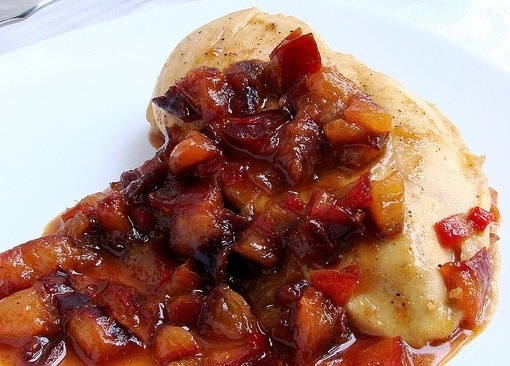
Apples & pears are staples in Belgium’s culinary repertoire. From ‘Luikse Stroop’ to ‘beer-braised rabbit with prunes’, Flemish cuisine often marries stewed or roasted fruits into its regional specialties. I love the savory & sweet combination of these flavors, and for that reason, chutney is winner in my book. I’ve played around with chutneys here & there, but it wasn’t until I came across a mango chutney recipe from an old edition of ‘Bon Appetit’, that I knew I had a winner on my hands. Since I love pears, I tweaked that recipe a bit to favor pears and… voilà! Get some cheese & crackers, and you’re all set for a true Belgian Fall favorite!

20130822-125601.jpg

ROASTED PEAR & PLUM CHUTNEY
(Adapted from a recipe by ‘Bon Appetit’)
– 2 ripe pears, peeled & cut in half (preferably Bosc pears or another firm variety)
– juice & zest of 1 lemon
– 1/4 cup + 1 Tbsp of sugar
– 3/4 tsp of ground cinnamon
– 1/4 tsp of ground cloves
– 2 Tbsp of canola oil (or another oil)
– 1/4 cup of pure maple syrup
– 2 shallots, halved and cut into slices/strips
– 1 clove of garlic, chopped finely
– 1 tsp of freshly grated ginger
– 3 Tbsp of currants (or dried blueberries works great as well!)
– 3 Tbsp of chopped dried figs
– 1/2 cup of champagne vinegar (or white wine vinegar)
– 1 tsp of hot red pepper flakes
– 1 tsp of fresh thyme, chopped finely
– 1 cup of ripe plums, diced small
– 1/4 cup of dry white wine

Preheat the oven to 350°F.

Toss the pears with the lemon juice, 1 tablespoon of the sugar, the cinnamon, and cloves. Line a baking sheet with aluminum foil and coat the foil with half the oil. Set the pears cut side down on the pan. Brush the pears with the remaining oil, and roast until caramelized and tender, approx. 40 to 50 minutes. Take out of the oven, and set aside to cool.

While the pears are roasting, bring all of the remaining ingredients to a boil in a non-reactive saucepan (like a Dutch oven). Reduce the heat and simmer for 5 minutes. Remove from the heat and allow to cool as well.

Using a small spoon, scoop out the cores of the cooked pears. Cut the pears into 1/2-inch slices. Combine the pears and the onion mixture. Cover and refrigerate for at least 1 day before serving.

Speculaas Cookies

20 Aug

Another blissful childhood memory of mine is ‘Sinterklaas’ day and the traditional ‘speculaas’ that comes with it. A typical Belgian holiday favorite, this spiced dark brown cookie is the star behind the ‘Biscoff’ speculoos cookie butter (or Trader Joe’s cookie butter) you see appearing on more & more American grocery shelves nowadays.

‘Speculaas’, or speculoos with double ‘o’, is readily available in Belgian grocery stores year-round, but its national primetime is definitely on ‘Sinterklaas’ day! Many bakeries press this deliciously spiced cookie dough in special wooden ‘speculaas’ molds, to create various imprints and shapes of the cookie, often with depictions of Sinterklaas.

20130820-191553.jpg

Top of the line pastry boutiques and fine bakeries even create toddler life-size Sinterklaas statuettes, that adorn their elaborately decorated & animated store windows and are admired by passers-by for their artistry with a sense of wonder.

‘Sinterklaas’ day, celebrated on 06th December, is deeply rooted in Catholicism since the Middle Ages. It is traditionally a celebration of Saint Nikolaus, patron saint of sailors, among others. Legend has it that Saint Nikolaus, a Greek bishop from the city of Myrna in present day Turkey, would roam the lands alongside the Mediterranean Sea, to remind folks of their religious duties. It is said he would preach about good moral values and spread cheer among the sailors’ families & children.

Sinterklaas festivities may seem insensitive to many Americans, but these traditional celebrations came long before they acquired any racial connotations later on in history. With the legend of Saint Nikolaus so deeply rooted in Catholicism and the religion’s pre-occupation with ‘good vs. evil’, the depiction of a ‘white’ holy man and his ‘black’ assistants has nothing to do with racial equality or differences… and everything to do with pitting good vs. evil. As such, Sinterklaas is depicted as a ‘good’ holy man, and his black assistants – Black Pete’s or ‘Zwarte Pieten’ – are meant to represent the ‘bad’ immoral influences we are tempted by. In that role, the ‘Zwarte Pieten’ are not meant to be depictions of actual humans, but rather portraited caricatures of frolicking, mischievous black devils that accompany the holy man to represent the evil influences that seemingly taunt us in our quest to be ‘good’. After all, if you were even remotely raised with deeply rooted religious beliefs, you have been warned a handful of times that the devil can take on any form to try and sway you from the ‘right’ path… Sinterklaas and Zwarte Piet truly are considered equals in the story, with each their own role to shine in, and the Black Pete’s form of dress is merely an accurate depiction of what men would wear during the medieval times in Moorish Spain, and not intended as mockery.

20130820-181716.jpg

In present day Belgium, Sinterklaas still arrives by boat and many port cities will stage and broadcast his arrival over national & local media. In smaller towns, Sinterklaas rides the streets on a white horse and visits local schools, grocery stores and other public buildings. Just like Santa Claus, Sinterklaas makes house calls the night before, and parents urge their children to place a shoe by the hearth or the front door, so Sinterklaas can leave candy & goodies overnight. The importance of leaving a carrot or two for his beloved equine companion, is equally stressed! Throughout the year, parents cleverly use the whole Sinterklaas story to urge their children to be ‘good’, because being ‘naughty’ results in being whisked away to hell in Black Pete’s burlap sack. As a child, this was a credible threat that one could not take lightly!

‘Sinterklaas’ day was always fun. It broke the academic tediousness of school. You knew that anything could happen on this day, and you’d keep your eye out in giddy excitement for a glimpse of any of the Black Petes or a sign they were present. Many times, we’d hear the ruckus & screeching from a few classrooms down, and your heart would start racing with whirly anticipation of Sinterklaas’ arrival into your classroom. The first ones to arrive, were always the ‘Zwarte Pieten’. One would come barging through the door, throwing candy around and sending kids clambering all over their desks to get some, while another would mischievously start writing on the blackboard with blatant spelling errors and disregard for the scholarly establishment… Yet another would start emptying or rearranging book shelves or cabinets, or sit down next to you whilst mimicking your every move, much to the excitement of your peers. With Sinterklaas striding into class elegantly, almost royally, he’d immediately reprimand the shenanigans of his assistants, and inquire in class to spill the beans on what his assistants had been up to so far. Many children will eagerly blurt out everything from A-Z in hopes of pleasing Sinterklaas, much to the staged chagrin of the Pete in question, while others – like Teutonic little me – would feel there was no place for all of this frivolity until such time it was revealed who was on the ‘good’ list and who on the ‘naughty’ list. This was serious business, folks!

Other than ‘speculaas’ and chocolate, Sinterklaas – said to be hailing from Spain – also brings mandarins, marzipan and ‘lieve vrouwtjes’ as well.
(*) a marshmallow type candy in the shape of the Holy Mary

20130820-184055.jpg

SPECULAAS SPICES
(Adapted from Flemish celebrity chef Piet Huysentruyt)
– 4 Tbsp ground cinnamon
– 1 Tbsp ground cloves
– 1 Tbsp ground mace
– 1/3 Tbsp ground ginger
– 1/4 Tbsp ground cardamom seed
– 1/4 Tbsp ground white pepper
– 1/4 Tbsp ground coriander seed
– 1/4 Tbsp ground anis seed
– 1/4 Tbsp ground nutmeg

Put everything in a ziplock baggy and shake well! Store in a small glass jar, in a cool dark place.

SPECULAAS COOKIES
(Adapted from a recipe by Flemish celebrity chef Jeroen Meus)
– 1 lbs light brown/golden sugar
– 1 lbs of pastry flour, self-rising flower or all purpose flour, sifted
– 8 oz of good quality butter, room temperature
– 1 egg, yolk & white separated
– 1-2 Tbsp of speculoos spices (see above. Use 2 for a spicy flavor)
– 1 tsp of baking soda
– 1 tsp pinch of salt

Combine all ingredients into a large mixing bowl, and mix with a mixer or your hands until you get a smooth dough that doesn’t stick to your hands. Wrap dough ball in plastic foil, and rest dough in the fridge overnight to allow spices to develop flavor and permeate the dough.

Preheat oven to 400F. Roll dough into a sausage, and slice into cookie slices. Alternatively, roll dough out on a floured surface, and use your cookie molds to cut out shapes.

Place cookie dough on a parchment paper lined baking sheet, and bake for approx. 25-30 min. Allow cookies to cool and crisp.

20130820-192241.jpg

Warm Lemony Dill Potato Bake

19 Aug

There is no doubt in my mind that I inherited my love for potatoes from my grandpa. He single-handedly ensured the success of many local potato farmers with his consumption of mashed potatoes alone.

Spuds are undeniably woven into Belgium’s patriotic fabric of life. No national or regional dish is truly complete without a side of potato being served alongside it. As such, you can find potato farms all over our western countryside, right alongside cabbage fields, pig farmers and dairy farms.

The first Spring after we moved into our new ranch-style house in the Flemish boonies, our yard and patio were overrun by Leptinotarsa Decemlineata, or striped Colorado potato beetles. It was a brand new housing development, and I bet those beetles were probably just as confused and challenged adapting to this new environment as I was.

20130819-202135.jpg (photo courtesy Brussels Museum of Entomology)

Aren’t they pretty?

As a little girl, I’d catch them and would create little artificial beetle colonies, complete with tiny dirt pathways and dandelion petal patches and all. It was like 5-star luxury resort-style living, at least in my mind. In hindsight, I was probably feared in Leptinotarsa circles, but my young soul had nothing but the best intentions at heart. The upside is, is that every evening at dusk, I was forced to release the inhabitants of ‘Beetleville’, and watched them scurry off in mass exodus. I wasn’t allowed to keep them as pets and mom demanded I set them free after a long day of forced communal living in an old, scraggly cardboard box.

Potatoes have always harbored happy memories for me. I truly love potatoes any which way, but the buttery oven-baked Yukon Golds are by far my favorite.

The genius of the recipe below is something I accidentally discovered when I knocked over a glass of freshly squeezed lemon juice I had set aside to make lemonade, and it went everywhere in my tiny apartment kitchen. I will not repeat the choice dialogue that escaped my otherwise proper mouth in that very moment, but will instead thank the cosmic forces for introducing me to ‘lemon potatoes‘. Since that divine intervention, I’ve tweaked the recipe a bit, but let me tell you, the tartness of fresh lemon juice pairs beautifully with the buttery creaminess of these Yukons. I urge you not to lose another minute. Go make these now.

20130819-201437.jpg

WARM LEMONY DILL POTATO BAKE
(Created by divine intervention and/or cosmic force)
– 1.5 lbs of Yukon Gold potatoes, cut into large pieces.
– zest & juice of 2 small fresh lemons
– 1 cup of water
– 3 Tbsp of olive oil
– 3 Tbsp of melted butter + more for buttering an oven dish
– a handful of fresh basil, finely shredded or chopped
– 3 cloves of garlic, minced or grated
– a handful of fresh dill, finely chopped
– a few sprigs of fresh parsley, finely chopped
– salt & pepper, to taste
– a sparse drizzle of honey

Preheat oven to 425F. Butter a large oven dish.

In a large bowl, add cubed potatoes with olive oil, water, chopped basil and salt & pepper, and mix with your hands to coat well. Pour into oven dish and cover with aluminum foil. Bake in the hot oven for approx. 15-20 min, until almost tender.

In the meantime, combine lemon juice, zest, garlic, melted butter, honey and chopped dill/parsley in small bowl.

Take potatoes out of the oven, uncover and pour lemon/butter mixture all over the potatoes. Place back in the hot oven and bake uncovered for an additional 20 min until water has evaporated and potatoes are tender.

These are so good when served lukewarm, but you could eat them cold or hot as well.

Spaghetti Bolognese

18 Aug

Yesterday was one of those rare days on which I didn’t really feel like cooking. We’d been mostly in our ‘weekend lazy‘ mode, and I didn’t get out of my purple penguin pajamas until well into the afternoon. Up until that moment in which I actually traded my cozy pj’s for cozy jeans & a tee, my most strenuous activity was whipping up grilled cheese sandwiches & a tomato salad for the beau & I… It took 20 minutes of thumbing through the newest edition of ‘Food & Wine’ whilst slouched in the couch, to recover from this sudden burst of activity. I know I will pay dearly for this laziness in the upcoming week, but it was nice for once to actually not be running up & down the stairs with laundry baskets and hauling 20 bags of groceries inside, as though I’m in some wacky episode of ‘Survivor-Special Homestead Edition‘.

The result of this pointless Saturday lull, was that after hours of watching my stepson play ‘Portal 2’ on his Xbox and browsing Pinterest and the likes on my phone, I actually started enjoying the nothingness of my Saturday and I morphed into the mother of all laziness. The longer it went on, the more ‘nothing’ I felt like doing… and then dinner time hit me. Like the hand of God himself striking me down for my indolence.

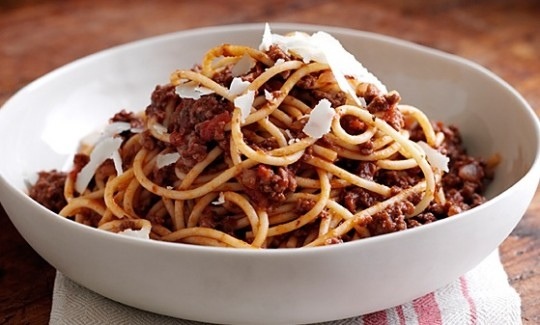
A quick peek in the fridge brought ground beef, onions & basil to the forefront, so spaghetti it was! I realize that I’m not adding an earth-shattering culinary oeuvre with posting a recipe for ‘spaghetti bolognese‘, but I thought I’d share my version of this classic nonetheless…

20130818-075626.jpg

SPAGHETTI BOLOGNESE
(Adapted from a recipe by Anne Burrell)
– 3 shallots, finely diced
– 2 large carrots, finely diced
– 3 ribs celery, finely diced
– 4 cloves garlic, minced or grated
– 3 lbs of lean ground beef
– 2 6oz cans of tomato paste
– 1 28oz can of crushed tomatoes
– 3 cups full-bodied red wine
– salt & pepper
– olive oil
– a pinch of cayenne pepper
– 3 bay leaves
– 1 bunch of thyme, tied in a bundle
– 1.5 lbs of dry spaghetti
– 1/2 cup grated or shaved Parmigiano-Reggiano

In food processor, puree onion, carrots, celery, & garlic into a coarse paste (or blend with a hand mixer).

In large pan heat olive oil and sauté veggie paste with a generous helping of salt, until most water has evaporated and they start to brown, approx 15 min.

Add ground beef & season generously with salt as well. Allow the beef to brown slowly, 15-20 mins.

Add tomato paste & cook til brown, 4 to 5 mins. Add red wine. Cook til wine reduces by half, another 4-5 mins.

Add crushed tomatoes and toss in bay leaves & bundle of thyme. Stir to combine all. Bring to boil, reduce heat to simmer and -ideally- simmer 3 1/2-4 hours to develop all the flavors. If the sauce gets to thick, add water. Finish sauce with salt & pepper to taste, and add a pinch of cayenne pepper for a bit of heat.

During last 30 mins, bring a large pot of water to boil. Pasta water should always be well salted, so don’t skimp on this. When water comes to a rolling boil, add pasta & cook for 1 minute less than package says. Reserve 1/2 cup pasta water.

Meanwhile remove 1/2 of the sauce from pot & reserve in a separate bowl.

Drain the pasta & add to the pot with 1/2 the sauce. Toss pasta to coat. Add some reserved sauce to achieve an even ratio between pasta & sauce.

Add reserved pasta water and cook pasta & sauce together over med heat until the water reduces. Turn off heat.

Give a big sprinkle of freshly grated or shaved Parmigiano Reggiano and a generous drizzle of good quality olive oil.

Buon Appetito!

Honey & Lime Roasted Carrots

17 Aug

I roasted these lovely carrots in combination with my deliciously crispy curried chicken drumsticks the other night. The sweetness & tanginess of these carrots pairs perfectly with the earthiness of the curry flavored drumlets. It was a budget-friendly marriage made in heaven, if you ask me.

20130817-093609.jpg

HONEY & LIME ROASTED CARROTS
(A Hungry Belgian original)
– 6-7 large carrots, peeled whole, or 10-12 mini carrots
– 2 shallots, roughly chopped
– 1 lime, zested & juiced
– 1/4 cup of olive oil
– 1 tsp of ground cumin
– 1 Tbsp of honey
– salt & pepper, to taste

Preheat oven to 425F.

Halve carrots lengthwise, and if using large ones, halve each half lengthwise again. Cut each quarter crosswise, so you end up with long carrot fries, so to speak.

In a large bowl, pour lemon zest, juice, olive oil & honey, and stir until well combined. Pour over the carrots & shallots, and toss to coat well.

Pour carrots, shallots and oil mixture onto a baking sheet, and sprinkle with cumin, salt & pepper.

Roast for approx. 30-45 min, until caramelized and charred around the edges. Bon Appetit!

Crispy Curried Chicken Drumlets

17 Aug

The other day, whilst thumbing through a glossy magazine, I came across an article on curry leaves and the history of the spice. Things like that completely stop me in my tracks, and I forgot I was actually standing in line in the store until a testy elderly lady in hot pink rhinestone embellished sweatpants angrily harped that it was my turn! She wore a matching jacket with the likeness of some Las Vegas idol sprawled across her chest, smiling broadly & winking as if though to say he scored himself a lucrative senior sweatshirt deal and was now kicking it with ‘Betty Boo’ here. With a twinge of mild irritation in her crackling, nicotine-damaged voice, she motioned towards the rapidly emptying conveyer belt and proceeded with giving me the stink eye for slowing her & Mr. Vegas down by 5 extra minutes. I snapped out of my curry leaves dream and apologetically resumed proper grocery store etiquette.

Because of the drama surrounding ‘the incident with the blue-haired coiffure’, I couldn’t tell you what I read anymore, other than that curry is way old and super versatile. Curry has got to be one of my favorite spices. It’s so warm and earthy, you can find it in a variety of heat levels and it colors your food a pleasing, happy yellow.

With our family’s poor man’s budget encouraging creative thinking, I picked up a 12-pack of chicken drumsticks and a few random items, and inadvertently came up with the deliciousness below… I hope you enjoy these too.

20130817-090745.jpg

CRISPY CURRIED CHICKEN DRUMLETS
(A Hungry Belgian original)
– 12 or more chicken drumsticks or thighs
– 1 14oz can of coconut milk
– 1 lime, zested
– 1.5 Tbsp of Sriracha sauce (or Harissa, Sambal Oelek or hot curry paste)
– 2-3 Tbsp of sweet curry powder (I use Penzey’s Spices, you can adjust as to how much curry flavor you want)
– 1.5 inch piece of fresh ginger root, peeled & grated
– salt & pepper, to taste
– fresh cilantro, for garnish

In a large container, pour all ingredients together other than the chicken & cilantro, and stir until well combined.

Rinse and pat chicken dry, and let marinate in the curried coconut milk mixture for at least 1-2 hours.

Preheat oven to 425F. Take drumsticks out of the marinade and place on a foil-lined baking sheet. Roast for approx. 30-45 minutes, until chicken is crispy and cooked through.

Serve with these lovely honey & lime roasted carrots, and rice.

Butter-braised Savoy Cabbage with Speck

16 Aug

Yesterday, my new Facebook friend Linda V. K. asked me if I knew what ‘wirsing’ means in English? While the word ‘wirsing’ is actually German for a lovely dish of butter-braised Savoy cabbage, the dish is decidedly Belgian in nature. Belgium is a land of country cooking & hearty food, and what could possibly be more country than cabbage?!

Whenever I see cabbage, I am instantly reminded of the frosted-over cabbage fields sprawled out over the western Flemish farm belt. The fields stretch for miles on end and are planted in perfectly straight rows, with dirt pathways cutting through the geometrical pattern like goat trails. Lone farmers tend to their crops with their weathered hands clad in woolen fingerless gloves, their rosy cheeks glowing like red beacons of life on the otherwise desolate, bleak fields. I used to cycle alongside these fields on my way to or from school, often pulling my sweater’s sleeves over my hands to give my fingers some relief from the icy morning fog that blankets these lands in Fall & Winter. I’m sure my mother’s ‘Don’t forget your gloves!!’ must have echoed a million times through our hallway.

When kicking off our snow-covered boots and darting over the frigid garage floor in our socks, the warmth of the kitchen and the aroma of butter-braised cabbage and browned sausage felt like the culinary equivalent of sitting by a warm hearth. In my post about braised red cabbage, I already proclaimed my love for the deep purple vegetable, but dark green Savoy cabbage was never all that popular. It’s a universal phenomenon for kids to dislike leafy green vegetables, and Belgian youth is no exception to this. I remember Bert & I used to heap butter and some of the sausage’s pan drippings over the green cabbage, to make it more palatable.

The recipe below is for Linda. As promised, it’s imported directly from a trusted source in small rural Flemish village. Photo courtesy goes entirely to Belgian celebrity chef Jeroen Meus.

20130816-104902.jpg

BUTTER BRAISED SAVOY CABBAGE WITH SPECK
(Adapted from a recipe by Jeroen Meus)
– 1/2 head of Savoy cabbage (or green cabbage)
– a small pinch of sodium bicarbonate, to retain the cabbage’s bright green color during cooking (*)
– 8 slices of thick cut bacon, chopped into small pieces
– ground nutmeg, to taste
– salt & pepper, to taste
– 3 Tbsp of good quality butter
– ¼ cup of heavy cream
(*) This is completely optional but safe and flavorless! Sodium Bicarbonate is similar to Alka-Seltzer, for instance, or other stomach acid drugs. You only need a little bit for a whole pot of water, and it will not affect the flavor of the dish, nor is it unsafe to use. Sodium Bicarbonate ensures that the bright green color of cabbage is preserved in the cooking process, as otherwise the cabbage turns into somewhat of a drab brownish green. Many restaurants use this trick to preserve the bright green color of many green vegetables.

For an authentic flavor, you will need a head of Savoy cabbage (see picture below), and you will also need 2 large pots or Dutch ovens.

Start with filling one of your pots with water and bring to a rolling boil. While the water is heating, clear tough ‘older’ leaves from the outside cabbage and discard (or compost!). Cut cabbage in half, reserving one half for later. For the other half, cut the hard core out of the middle and cut that half in half again, so you end up with 2 quarter cabbage parts. Slice each cabbage quarter in very thin strips.

When the water is boiling, add a pinch of sodium bicarbonate to ensure the cabbage retains its bright green color. Add chopped cabbage, and simmer (blanch) for approx. 3-4 min until cabbage is crisp tender. Pour cabbage into a colander, and drain very well.

In the second pan, add 1 Tbsp of butter and brown bacon pieces until crisp, approx. 10 minutes. Reserve a few bacon bits for garnish. Add well-drained cabbage and sauté for 2-3 minutes more until cabbage is soft and well combined. Fold 2 Tbsp of butter and cream into the braised cabbage, and season with salt, pepper & ground nutmeg to taste. Sprinkle reserved bacon bits over the top and serve with browned sausage or you favorite protein.

Another Belgian classic! Enjoy!

20130816-104828.jpg