Archive | 2013

Blue Cheese Potato & Rutabaga Gratin

1 Aug

Belgium is big on potatoes, hence our national love affair with French fries… Potatoes were also my grandpa’s favorite dish, and genetically, I think that’s where I got my potato-love from. He especially liked mashed potatoes, with loads of butter & cream, to the point where they had to be served in a shallow bowl to ensure all that buttery deliciousness didn’t land on the antique parquet floors.

To further add to my love for potatoes, both mom & dad would take me to local farms for basic provisions like milk & eggs, butter, tomatoes… I was very little and I don’t remember many of them, but I do vividly recall one of them. It had a stone arched entrance with large, cast-iron gate doors that creaked when you pushed them open, and the old stone farm house & buildings were wrapped around a cobblestone courtyard, complete with the prerequisite droppings of horse manure and hay shoveled in the corner. The grounds were guarded by a large mutt that once bit my brother in the ass was allowed to roam freely and would come barrelling down towards you, stopping only a few feet shy, and then taunt you with his bark until the farm hands would shoo it away. You never knew which corner ‘the creature’ would come from, and as a little girl, that made me grasp my mother’s pants extra-tightly out of fear for death by wild canine. To further confirm my belief that this was purgatory, the plump farmer’s wife would often beckon us into the farm house in her stained apron and with a semi-toothless smile, and then proceed with pinching my cheeks with her callused, rancit smelling hands. The farm ‘office’ had several yellow sticky fly traps hanging from the ceiling with a handful of flies desperately trying to free themselves from certain death, and I always tried not to look at those things, because it made my little heart weep for the shimmering blue-green souls. The only upside I remember about that particular farm was that we were allowed to play on the potato fields whilst serious business was conducted inside the office. On occasion, we’d be handed a small garden shovel by a farm hand and asked if we’d like to go digging for spuds. I loved digging for potatoes! To me, it was like hunting for buried treasure: you never knew whether you’d come up with tiny little ones or the BIG monster kind that earned you serious bragging rights. Our loot would be taken home and prepared, and somehow it always tasted waaayyy better then when we’d buy potatoes from the store. I think I learned early on that farm fresh food tastes better then the stuff you buy in the grocery store.

Just like my opa, potatoes have a special place in my heart and on my hips. Belgian cuisine is the more down-to-earth sibling of French cuisine, and as such it is heavily French influenced. However, being more of a hearty meat & potatoes kind of country, we worship the lowly tuberous crop alongside many other root vegetables like turnips, carrots, parsnips, rutabaga etc. Potato gratin is one of those dishes that seem to always make it to family get-togethers during holidays or festivities, and often in duplicate too. I’m not sure where precisely I got the recipe below from, but I think I based it loosely on ‘Gratin Dauphinois’ and then sort of made it my own over the years.
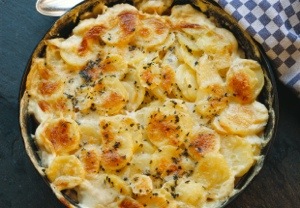
20130801-154359.jpg

BLUE CHEESE POTATO & RUTABAGA GRATIN
– 1.5 lbs of firm-cooking potatoes (Yukon Gold, for instance), more or less even in diameter
– 4-5 medium rutabaga
– 3-4 cloves of garlic, minced or grated
– 1 cup of heavy cream
– 1/2 cup of half & half
– ½ cup of chopped fresh thyme
– 6-8 oz of Gruyere cheese, shredded
– 4 oz of blue cheese crumbles (Danish Blue or Roquefort work great)

Heat oven to 375F. Peel and wash potatoes. Peel rutabagas. With your mandolin slicer, slice potatoes and rutabagas into thin, even slices (approx. 1/8 inch thick).

Butter an oven pan on all our sides. In the bottom of the pan, make a ¼ inch layer of the potato slices and rutabaga slices combined (you can mix & match them, so your ¼ inch thick layer has a bit of both), overlapping them a bit. Sprinkle with some of the blue cheese and a bit of the fresh thyme, then lightly toss some gruyere over top. Repeat this process until you reach the top of your pan. Reserve about 3-4 oz of the gruyere and set aside.

In a small bowl, combine milk & cream, add /minced grated garlic and salt & pepper to taste. Add remaining thyme, if you have any, and give everything a good stir. Pour all of it over the potato/rutabaga mixture in your pan. The cream mixture will thicken as the potatoes release their starch, so don’t worry if it looks a bit too soupy at first. Cover pan and cook in a 375F oven for approx. 30-45 min, until potatoes & rutabaga are tender and easily pricked with a fork. Uncover, sprinkle remaining Gruyere over the top and brown until the broiler until cheese is nicely melted, a bit browned on the edges & bubbly.

Princess Slaw

31 Jul

I would be lacking proper patriotic pride if I didn’t feature something ‘witlof’ on here. After all, this bitter leafy vegetable ‘is’ Belgium’s pride, so much so, that it is commonly referred to as Belgian Endive in English. Like Vegas brides, witlof was discovered entirely by chance. The story goes that it was someone at the Botanical Gardens in Brussels who happened to store chicory roots in a dark cellar, and then later discovered that they had produced fragrant white leaves. Like so:

20130731-185721.jpg

In 1872 some of this ‘witlof’ was sent to Paris, where it was later show-cased in an exhibition… and everybody lived happily ever after! Well, maybe not everybody.

As a child, I was never a big fan of raw witlof. Braised, these little cabbages caramelize and turn somewhat sweet, but left raw, the white leaves have a rather bitter crunchy bite. At the time, my juvenile palette wasn’t ready to embrace this without a fight, especially not considering there were sweeter salad options available. Nonetheless, mom loved endive salads and so we ate them. As odd as it may sound to America’s culture of coddling its brood, Belgian children typically grow up eating whatever the adults eat around the table, give or take the prerequisite portion control or cutesy approach to prevent excessive sulking. Being a foodie herself, mom was particularly insistent on expanding our palettes and exposing us to different flavors and foods from around the globe. Her tenacity in this fiercely rivaled my stubbornness, to the point where she once cooked spinach 4 days in a row and fed it to me with each meal, simply because I refused to eat the required 3 spoonfuls for good measure. Four whole days!!! If I even remotely hinted that I was hungry, I’d be at the table with my darned reheated bowl of spinach. I endured four days of ‘spinach prison’, before my young brain grasped the concept that I wasn’t going to win this one… um, yeah. Not that I’m stubborn or anything.

But, we digress… Yesterday, my Flemisch childhood friend Hadewych private-messaged me over Facebook to sing praise about my blog (she’s very pretty AND intelligent!), and asked if I was going to feature witlof and root vegetables, as these are true Belgian staples. She shared a recipe for a delicious, crisp witlof salad with red beets and happened to mention, tongue-in-cheek, that she calls it ‘Princess Slaw’ since the beets give the salad a pink hue and her young daughter Sam is easily bribed with anything pink and/or “princess” these days… Hadewych: 1 – Sam: 0.

With Belgian Endive costing you your first born an arm & a leg over here, and our finances seriously challenged, I got creative and played around a bit with Hadewych’s salad recipe. However, originally this slaw is made with thinly sliced witlof, rather than fennel. My more budget-friendly version below is still pink, so I’m sticking with ‘Princess Slaw’. In honor of a little blue-eyed girl named Sam.

20130731-181609.jpg

PRINCESS SLAW
(Adapted from super-mom Hadewych’s recipe)
– 1 large red beet, roasted (*)
– 1 tart apple, like Granny Smith
– 1 small/medium fennel bulb
– 2 Tbsp of good plain mayonnaise
– 3 Tbsp of Greek yogurt (or crème fraiche)
– juice & zest of 1 lemon
– 1 tsp of good mustard
– 1-2 Tbsp of chopped fresh parsley
– salt & pepper, to taste
(*) When working with beets, it is good to know that they will stain not only your hands, but also any porous material you place them on. If you don’t like your equipment or hands turning a bright pink, use a plate to cut them. The color will wash off of your hands after a few washes, but you could also wear latex gloves.

Heat oven to 400F. Cut stems off of the beets (no need to peel the beets!), and wash them so you get rid off all the dirt. Wrap each beet individually in aluminum foil. Place in the hot oven and roast until beet is fork-tender. For a tennis ball-size beet, this will be approx. 45 min.
Take beet out of the oven, and let cool until able to handle. Unwrap and rub beet under cool running water. The skin will slip right off without much effort! Chop into small cubes.

While the beet roasts, zest lemon and squeeze juice into a small bowl. Add mayo, yogurt, mustard and salt & pepper, to taste. Stir until you get a smooth dressing. Set aside and let flavors develop a bit.

Cute stems and ends of the fennel. Remove outer layer, and cube fennel heart in very small dice or slice thinly. Peel & chop apple into small dice as well.
Add chopped beet to bowl with fennel & apple. Pour dressing over the top and stir to coat everything. The slaw will turn bright pink. Sprinkle some roughly chopped fresh parsley over the top.

If you are a fan of raw beets, which I am not so much, you can also roughly grate a raw beet and the apple with your box grater, and combine it with with the thinly sliced witlof or fennel. Enjoy!

Baba Ganoush with Goat Cheese & Olives

29 Jul

In my post about Moroccan Spiced Meatloaf, I mentioned that I was at one time blessed to have lived in the buzzing, ethnic heart of Ghent, Belgium’s third largest city and melting pot of all kinds of Eastern cuisines.

I first discovered ‘Baba Ganoush’ in a small, dimly lit Turkish restaurant, complete with ornate belly-dancers and Kelim-covered poofs that served as seats around the knee-high, mahogany table tops. We had made our reservations a few weeks ahead of time, but when we arrived, somehow our reservation got botched and we had to wait well over an hour for our table. It turns out that this was actually a blessing in disguise, as the incredibly hospitable owner catered to us with gratuitous grilled pita bread and baba ganoush. Farouk, the bartender who made sure we weren’t thinking about the time that passed, kept the wine & conversation flowing with flair, and in the end, we sort of regretted being escorted to our table. To me, baba ganoush represents the warmth & earthy deliciousness of the flavorful ethnic dishes you find in the many small, family-run eateries in Belgium’s urban areas. Just like Mexican cuisine has become a staple in every day living in California, shoarma, doner kebab & things like baba ganoush are part of every day life in Belgium.

If you’ve never heard of baba ganoush, I urge you to keep an open mind as all it really is, is nothing more than a silky smooth & velvety roasted eggplant dip. It’s truly a bit of heaven in a small bowl. It’s perfect on bread or with pita chips, but also as a dip for roasted vegetables or a spread for sandwiches. It’s very versatile, and you’ll understand why the minute your lips meet this Middle-Eastern treasure.

20130730-125605.jpg

BABA GANOUSH WITH KALAMATA OLIVES & GOAT CHEESE
(Adapted from a recipe by ‘The Magic Carpet’)
– 2 large eggplant(s), whole
– 3-4 cloves of garlic, grated (use more for garlicky, and less for mild)
– 1 scallion, finely chopped
– 1/4 cup of tahini (*)
– 3 Tbsp of mild soft goat cheese (or thick Greek yogurt)
– juice of 1 small fresh lemon
– 1/3 cup of finely chopped fresh flat-leaf parsley
– 1 tsp of ground cumin
– 1 tsp of smoked paprika
– 1/3 cup of finely chopped kalamata olives
– salt & pepper to taste
(*) Tahini is a paste that is similar in texture than peanut butter, but made from sesame seed, instead. It can usually be found at local specialty grocery stores.

Heat oven to 375F (200C). Wash eggplant and prick them all over with a fork. Roast in the oven, whole, for approx. 45-60 minutes until the skin is blackened and the flesh is soft.

Let cool and peel eggplant. When they are soft and perfectly roasted, this should be very easy.
Slice off the top of each eggplant and place peeled flesh in a large bowl, together with the garlic and spring onion. Purée with a hand mixer until you get a smooth consistency, or mash it all by hand with a fork.

Add the tahini, lemon juice, goat cheese, spices and chopped parsley, and stir together until well combined. Season with salt & pepper to taste. Add a pinch of cayenne pepper for a bit of heat.

Heap chopped olives on top. Drizzle with olive oil, sprinkle some toasted pine nuts over the top, and serve with wedges of pita bread or grilled toast.

Curried Zucchini Cakes

29 Jul

My good friend Glynis posted a picture of her delicious home-grown zucchini crop on Instagram the other day, and freely confessed she had been on the hunt for zucchini recipes on Pinterest lately. My mind instantly went to a stack of curried zucchini cakes I whipped up months ago. I think last time I thought about frying up zucchini cakes in my skillet was probably when one of my colleagues arrived at my desk with a bag of monster-squash. She had grown them from seedlings and – by the sentiment in her voice – I could tell she felt comforted knowing her squash babies’ were going to someone who would love them as much as she did… I thanked her for sharing her glass house crop, and promised her I’d turn them into something magically delicious for lunch. Like Mary Poppins. Almost.

I’m not sure if these things happen to just me or everybody else, but at times I think my brain just randomly archives itself when it reaches system overload on all the foodie stuff. There are certain dishes I love and vow to put on regular rotation, and then, for some bizarre reason, I completely forget about them for months! Zucchini cakes are one of them. Every time I fry them up I fall in love with their crisp deliciousness and that token dollop of tart crème fraîche that goes on top, but somehow it nearly always takes some sort of a visual stimulus, like Glynis’ Instagram picture, for me to go “oooohhh, zucchini cakes!”.

I figured that I should post these forgotten gems on my blog, and hopefully I won’t forget about them anymore. Right.

20130729-173822.jpg

CURRIED ZUCCHINI CAKES WITH GOAT CHEESE & PINE NUTS
– 4-5 small zucchini, grated (approx. 2 cups)
– 2 small carrots, grated (approx. 1/2 cup)
– 1/2 of a small onion, grated
– 2 Tbsp of finely chopped fresh dill
– 1/2 cup of feta cheese, crumbled
– juice of 1 lemon
– 1 cup of flour
– 3 eggs
– 1.5 Tbsp of sweet curry powder
– salt & pepper, to taste
– olive oil, for pan-frying
– mild goat cheese (*)
– toasted pine nuts
(*) Soledad‘s lemon-lavender goat cheese is delicious with these fritters!

Grate zucchini and place in a cheesecloth-lined strainer. Sprinkle with a pinch of salt and lemon juice, and let drain for 15-20 minutes. Afterwards, take zucchini and squeeze excess out of the vegetables. Place in a large bowl.

Add grated carrot and onion, eggs, flour, feta cheese, dill, and curry powder, and combine into a chunky batter. Add salt/pepper taste.

In a heavy skillet, heat olive oil until nice and hot (but not smoking) over medium heat. Place a hefty scoop of batter in the pan and press down a bit to flatten out. Cook until brown & crisped, +/- 4 minutes. Flip over and brown the other side.

Transfer to a 200F oven to keep warm, while you cook the rest in batches.

In a separate pan, toast pine nuts for a minute or so. Be careful, cause they burn easily!

Serve the zucchini cakes while still warm & crisp, with a dollop of goat cheese on top and a sprinkle of toasted pine nuts.

Five Cheese Mac

27 Jul

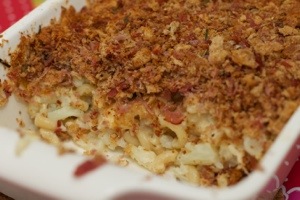
One of the many fabulous dishes America welcomed with me when I first arrived here nearly 13 years ago, is a bubbly & cheesy mac straight out of a hot oven.

Sure, there are oven-baked cheesy noodle dishes in Belgium too, but they’re falling dramatically short from the cheesy, creamy deliciousness I’ve enjoyed on this side of the Atlantic. For starters, Belgian macaroni and cheese dishes lack flair and creativity, in my opinion. Almost as if nobody cared to explore the culinary possibilities of this American staple. Overall, I think American cuisine gets a bad wrap in Europe due to all the sub-par hamburger chains and cheap fast food joints that are being lobbied as a slice of ‘real’ American life. It’s entirely false, and I’ll come right out saying that I’ve enjoyed some amazing cooking & food here. So to whomever put mac ‘n cheese on the culinary map, I thank thee! (Oh, and a special thank you shout-out to Vermont extra-sharp white cheddar, Maine lobster, Alaskan king salmon, Georgia peach cobbler, Boston cream pie, Mississippi mud pie, California avocados, Texas BBQ, Missouri’s St. Louis style ribs, Hawaii’s macadamia nut crusted mahi mahi & pupus, New York cheesecake… Yeah, I rest my case).

Over the years, I’ve played around with many mac ‘n cheese recipes I found online, but I finally settled on my own creation below, which is more of a grown-up mac and has bit more depth of flavor. I hope you enjoy it as much as my family & I do.

20130728-111857.jpg

FIVE CHEESE MAC
(Adapted from a variety of recipes I found online)
For the cheese sauce:
– 1 quart of milk
– 1/2 cup of flour
– 8 Tbsp of good quality butter
– 1/4 cup of buffalo hot wing sauce (*)
– 6 oz of Brie, sliced with rind on
– 12 oz of Gruyere (or Swiss cheese), grated
– 6 oz of extra-sharp white cheddar, grated
– 6 oz of mild cheddar, grated
– 4oz of blue cheese, crumbled
(*) I shamelessly stole this idea from the Hard Rock Cafe in Hollywood! It gives the sauce a bit of a kick in the pants.

Make a simple bechamel sauce, by melting the butter in a pan and adding the flour. Cook for a minute until flour & butter are one, then add milk and stir until all lumps are gone. Bring to a simmer and stir until the sauce thickens. When thick, remove from heat and incorporate all cheeses into hot sauce. Add buffalo wing sauce and season with salt & pepper to your liking. Add a pinch of nutmeg.

For the mac ‘n cheese:
– 12 slices of thick cut bacon
– 1 cup of breadcrumbs or crushed corn flakes (I use corn fakes because they add a nice touch of sweetness)
– 2 Tbsp of melted butter
– 2 boxes of elbow macaroni or cavatapi, or another kind of small pasta noodle.
– 3 Tbsp of finely chopped fresh rosemary (optional)

Heat oven to 400F. Lay bacon slices out on a foil-lined baking sheet, bake in the hot oven for 15-20 minutes until browned and crisp. Set aside and let cool slightly until your are able to crumble the bacon by hand. Turn oven down to 350F.

In the meantime, bring large pot of water to a boil and cook pasta according to box instructions until “al dente”.

Drain cooked pasta and place in a large oven dish. Pour cheese sauce over it and crumble bacon all over the top. Fold sauce and bacon into the pasta, then sprinkle the top with the breadcrumbs or corn flakes and drizzle melted butter evenly over the top. Sprinkle top with chopped rosemary. Bake for 45min or so until it’s bubbly and the top layer has crisped.

So good!

Brussels’ Waffles

26 Jul

A thing that always makes me chuckle a bit inside and silently go pffft!, is when my American friends ask me about ‘Belgian’ waffles… It’s not that there’s anything wrong with that question, nor do I mock the inquisitor, it’s just that there’s many different kinds of waffles and for a Belgian, there’s no such thing as a ‘Belgian’ waffle. For starters, there’s the ‘Liege’ sugar waffle with crunchy bits of pearled sugar baked into them and usually served gooey & hot, then there’s the ‘vanilla’ variety which has more of a dry, crumbly tea cake consistency and is frequently sold pre-packaged in the grocery store, or the ‘Stroopwafels’ you find near the border with Holland, which are traditionally filled with a buttery caramel… just to name a few. But for the sake of good cross-cultural understanding, I can tell you that the traditional ‘Belgian’ waffle, adored by so many, is actually a yeast waffle from the city of Brussels.

Airy, fluffy and light on the inside, they’re browned to a buttery crisp on the outside, with just enough sweetness & crunch to please every palette. As a regular pitstop on our way home from the ‘Museum of Natural History’ or the ‘School Museum’, it’s exactly the kind of waffle my grandpa would look forward to when he’d ring the bell & we’d step off the busy tram. He’d eagerly grab it with both hands, skillfully balancing the sugared whipped cream on top, and bite into it with such gusto, that his custom-made pearly whites would cling to the deliciousness the minute he’d pull the waffle out of his mouth, and we’d snort with laughter. Not that that ever happened! Carry on.

‘Brusselse wafels’ rose to fame (pardon the pun) because of one special guest appearance: YEAST! Yeast dough is like the Ella Fitzgerald of all pastry doughs: jazzy, smooth and easy to digest. Think about it. It’s no surprise that doughnuts made with yeast are 10x more delicious than the ones who aren’t… Krispy Kreme? Anyone?

Here’s an homage to a true Belgian classic. (Fixodent not included…)

20130726-212033.jpg

BRUSSELS’ WAFFLES
(from grandma’s handwritten recipe booklet…)
– 3 farm fresh eggs, yolks & whites separated
– 12 oz of warmed milk, preferably whole
– 3/4 oz of fresh yeast (or 1 packet of dry active yeast)
– 12 oz of sparkling water, room temperature
– 16 3/4 oz of self-rising flour (approx. 3.5 cups), sifted
– 5.3 oz of good butter (approx. 10.5 Tbsp)
– a pinch of salt
– 1-2 Tbsp of sugar

Heat waffle iron until it’s piping hot!

Seperate egg whites and yolks in two bowls, and set aside.

Warm milk and combine with yeast and sugar. Allow to bloom for 10 min.

Lightly beat yolks and add warmed milk and yeast. Beat until incorporated, then add sparkling water and stir gently until well-combined. Sift flour directly into the milk mixture, beat with an electric mixer until all lumps are smoothed out.
Melt butter in a small sauce pan and beat egg whites into stiff peaks. Pour melted butter into batter and gently fold in stiffened egg whites by hand, and add a pinch of salt as well. Set batter aside for 20-30 minutes, so yeast can work and batter has time to rise.

When the batter shows bubbles an appears “alive”, you’re ready to start baking!

Make sure to butter all sides of your waffle iron, regardless of whether it is non-sticker not. Pour 1/3 cup of batter per waffle, and allow waffle to brown completely. Every waffle iron is different, so it’s a bit hard for me to say how long this will take with your machine. You want the waffles to be crisp and brown on the outside.

Serve with powdered sugar, brown sugar or whipped cream for an authentic Belgian treat… or go a bit crazy and add crisped bacon, ham or cheese to the batter for a hearty salty & sweet combination!

Melanie’s Promised Lasagna

26 Jul

Belgians are gregarious people by nature. We enjoy mingling with friends & family in our local cafés, and we love food & drink as much as we enjoy engaging in theatrical debates about the linguistic & political divide in the country. Most of this bickering takes place over a few pints of ‘Maes Pils’ or ‘Leffe’, and the more freely beer flows, the better we seem to understand each other. Heated arguments nearly always end in boisterous laughter and an amicable pat on the back, and a family size paper pack of mayo-laden French fries is never far away. While it’s widely known for Italians to visually paint their verbal language with dramatic hand gestures & body language, you’ll find similar story-telling antics in Belgium. For instance, mom has always been exceptionally talented in adding depth to her words with dramatic facial expressions and colorful hand gestures. I’ve secretly pondered if perhaps she isn’t part Italian, a belief that was reinforced by her uncanny ability to cook a mean spaghetti.

Which brings me to Italian food… Italian cuisine is celebrated everywhere in the world and Belgium is no exception to this. Our people embrace pasta and Parmigiano Reggiano like no other, and our towns are dotted with colorful red/white/green pizzerias and rustic trattorias. We didn’t get to eat out very often, but during town festivities or family gettogethers, when the ever-watchful eye of mom wasn’t so watchful, we’d gorge on Italian wedding cake and forbidden fruit cream soda like there was no tomorrow. Italian food has always been a sultry lover of mine. Despite my best New Year’s resolutions, I can’t seem to resist its salty cheeses, wine-cured meats or dreamy pastas… It’s no wonder then that I sometimes ‘go to the mattresses…’ in my small apartment kitchen, and bake lasagna from scratch, leaving the kitchen looking like a bloody scene out of ‘The Godfather’. The tomato-mess is well worth the army-size supply of lasagna we end up, as I haven’t quite mastered the art of portion control just yet.

Half a year ago A little while ago, I brought lasagna leftovers to the office and shared them with my colleague Melanie F. It was amore at the first bite. She’s asked me for the recipe ever since, but has been patiently waiting for my procrastination to die down naturally. In talking about my blog the other day, she jokingly reminded me I still owed her that recipe, so I crossed over to the pimp-side and promised her I’d post it if she’d become a follower on my blog… Yeah. I’m that cheap, y’all. So without further ado, here’s Melanie’s promised lasagna recipe…

20130726-150543.jpg

MELANIE’S PROMISED LASAGNA
For the meat sauce:
– 1 large carrot, grated
– 2 shallots, grated
– 2 ribs of celery, grated
– 2 28oz cans of crushed tomatoes
– 1 8oz can of tomato paste
– 12 oz of chianti (or any dry red wine)
– 1 lbs of ground beef (extra lean)
– 1 lbs of Italian sausage, casings removed (hot or sweet, but I prefer sweet)
– 1 large onion, finely chopped
– 6 small cloves of garlic, pressed or minced
– 1.5 cups of fresh basil, chopped
– salt & pepper, to taste

In a large heavy pan, sauté the grated carrot, celery & shallot (aka ‘mire poix’) until fragrant and beginning to brown. Add garlic and sauté for a minute or so longer so the garlic has time to release its flavor a bit. Add chopped onions and brown until translucent and soft. Add the meats and brown until crumbled and mostly done. Add tomato paste and brown 2-3 minutes longer until tomato paste gets a deep brownish red color. Douse with half of the chianti and let reduce until most of the wine has evaporated. Add crushed tomatoes, rest of the chianti and salt & pepper, and simmer without the lid until all of the watery liquid has evaporated and you achieve a thick sauce. Fold chopped basil in the sauce and season with salt & pepper to your liking.

For the creamy béchamel-like sauce
– 2 15oz tins of ricotta cheese
– 2 cups of milk
– 2 Tbsp of butter
– 2 Tbsp of all-purpose flour
– pinch of nutmeg
– pinch of cayenne
– salt & pepper

Melt butter in a sauce pan. When butter is melted, add flour and cook for 1 minute until an even ‘paste-like’ consistency forms. Slowly incorporate milk and bring to a boil over medium heat. Sauce should start thickening fairly soon when milk simmers. When béchamel sauce is ready, stir in a pinch of nutmeg, salt & pepper to taste. Take pan off of the stove, and add 2 tins of ricotta cheese. Fold until you get a thick, creamy, pudding-like consistency. Salt & pepper to taste.

Building the lasagna:
– 2-3 boxes of lasagna noodles, par-boiled & drained (or use the ‘no-cook’ kind)
– 3 cups of Parmesan cheese + Pecorino Romano, freshly grated by hand

Heat oven to 375F. Butter a large deep oven-pan. Spread a few Tbsp of the meaty tomato sauce to coat the bottom & prevent noodles from sticking to the pan, and place a layer of noodles on top of the sauce. Overlap the noodles’ egdes slightly. Then, evenly spread a thick layer of the ricotta/béchamel sauce over the noodles (careful not to shift the noodles too much) and sprinkle liberally with grated cheese so the cheese covers most of the béchamel sauce. Top with an equal layer of the meaty tomato sauce, then add another layer of cooked noodles on top of the tomato sauce. Repeat this process 2 more times until your dish is full (+/- 3 layers) and you finish with a top layer of tomato sauce. Simply sprinkle grated cheese directly on top of the tomato sauce, and bake in the oven for approx. 45-60 minutes until heated through and cheese on top is bubbly and brown.

Serve with crusty bread and a nice glass of Chianti.

Dilled Cucumber Salad

25 Jul

Belgian Summers are notoriously finicky. Either the weather stays fairly overcast and entirely too cold for the time of the year, or the country is hit with a sweltering, oppressive heat wave that makes you wish you never cursed the wet dreariness from the past 7 months in the first place. With temperatures generally hovering between ‘%$!@, it’s freezing!!’ and ‘jeez, it’s still raining?!’, most brick homes are not equipped with central cooling either. During these brutally hot summers, windows and doors would be propped open, protected by colorful ribbon-screens to keep flies & bugs out (*), and you’d at least get the illusion of air circulating. Buckled under Mother Nature’s oppressive grip, I swear you could practically hear a faint, collective moan wafting through the air.
(*) unless you lived in our home, where a certain someone that I am not naming, thought it was fun to braid those vibrantly colored ribbons together into a visually pleasing work of art, and you’d inadvertently end up with the mother-ship of all mosquito colonies in your house. I’m not proud of it.

On those blistering days, we predominantly lived in our grassy backyard, barefooted. I can’t remember a Summer day on which we did not precariously shuffle a tray of plates & silverware to our teak-wood table. Our dinners on these sultry evenings were long family gatherings, in which we’d eat for a few hours by citronella candles and watch the threatening thunderstorms crack & pour down from underneath the comfort of our covered garden patio. The crisp cool air that followed these torrential Summer storms, made it all worthwhile.

Requesting a cooked meal on these sweltering days would have sent any respectable housewife into a tizzy, but our mom merely looked us in the eye with James Bond-like ‘cool’ and would calmly announce we’d be having salad for dinner, with some sort of barbecued meat, to distinguish lunch from dinner. For good housekeeping measure.

Mom got very creative with salads, and I remember loving most of them. Those summertime salads were also my first introduction to – insert dramatic drum roll here – the mandolin slicer! I think I must have been all of about 7-8 years old when I was allowed to touch one very carefully under the watchful eye of El Commandante mom, and was specifically instructed to always use the protective guard that comes with any mandolin slicer. Ha! The irony.

The crisp cucumber salad below is one of my favorites in my salad repertoire. It’s a play on Greek tzatziki. I think I got this recipe from mom, but I’m not entirely sure as it’s one of these dishes that just live in my head and surface out of nowhere. Either way, this tangy refreshing salad is perfect for hot Summer days…

20130725-141011.jpg

DILLED CUCUMBER SALAD
(Inspired by Greek tzaziki)
– 4 seedless cucumbers, preferably hot house
– 16 oz of Bulgarian yogurt (or plain yogurt. Not the thick Greek-style yogurt)
– 1 Tbsp of white wine vinegar
– juice of 1 fresh lemon
– 3 Tbsp of extra-virgin olive oil
– 2 cloves of garlic, depending on size & strength, pressed or minced (or more)
– 2 Tbsp of fresh dill, chopped
– 2 Tbsp of fresh mint, chopped
– a handful of fresh chives, chopped
– 1 Tbsp of fresh lemon zest
– salt & pepper, to taste

Half & seed cucumbers lengthwise, and slice into very even, medium-thickness slices. A mandolin slicer works great here, but watch your fingers and knuckles. (not that I know anything about that! OK???) Place slices in a colander or sieve, and sprinkle liberally with salt. Place something heavy directly on top of the slices of cucumber, and let them drain out 15 min or so bit over the sink.
In a large bowl, combine yogurt with olive oil, lemon juice and white wine vinegar. Stir until you get an even consistency, it should be fairly liquid, dressing consistency. If it’s not enough, add a splash of water. Add garlic one clove at a time, and taste to desired garlicky-ness. Add salt & pepper to taste as well.
Add cucumber slices and fold until everything is well-coated. Fold in chopped herbs and cover. Set in the refrigerator for at least 30 minutes, so cucumbers have time to absorb the delicious yogurt vinaigrette.

Perfect as a side with grilled shrimp or salmon!

Banana Butter

24 Jul

It is no secret that there was a lot of banana-love to go around in our humble, ranch-style country home. As a matter of fact, my brother & I loved them so much that – to this day – we both vividly recall a traumatic very unfortunate episode from our youth in which mom decided to stock up on canned bananas, in an effort to meet basic supply & demand on a teacher’s budget. Since our mother was of the ‘no-nonsense’ type breed, she didn’t just buy a single can or two to give them a try. NO! She went ahead and bought a Costco-size pallet of them, to ensure she’d get us through the banana-famine that were our harsh Belgian Winters back in the day. Her heart was in the right place, but seriously mom?! Canned bananas???

If you’ve never heard of ‘canned’ bananas, go hug your mom now and thank her for not crossing over to the dark side. They were, for lack of better wording, nasty! Mom Tootsie Farklepants didn’t help the matter by maintaining a strict zero-tolerance policy in wasting food so… There you have it. I’ll spare you the gory detail, but let’s just say that for several months later, you would find partially-chewed canned bananas stuffed in the most peculiar places. Including our lawnmower.

None of this was enough to kill my banana-love, though. Nothing makes me happier in the morning than a warm, toasted English muffin, schmeared with butter and topped with honey-drizzled sliced bananas. Yum!

I have to include a moment here to thank ‘Lucille’s Smokehouse’ for feeding me that delicious apple-butter that comes with their sweet, warm biscuits. The recipe below was totally inspired by that genius, so I owe them at least an honorable mentioning.

20130724-214349.jpg

BANANA BUTTER
(Inspired by ‘Lucille’s Smokehouse’)
– 1 stick of room-temperature butter
– 1/2 of a very ripe banana
– 1/3 of a small, sweet apple, grated
– 1/4 cup of agave syrup (or honey)
– 1/2 tsp of cinnamon
– a pinch of grated nutmeg
– a pinch of ground clove

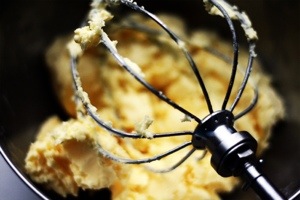
In the bowl of a food processor or mixer, combine all the inredients until well-combined & blended. Scoop mixture onto parchment paper and make a 1-1.5 inch roll out of it. Twist ends of the parchment to press butter roll together. Place roll in the refrigerator and allow to firm up for a few hours.

Coincidentally, this sweet butter goes great with the crepes I posted the other day, or melt a slice of the butter into some warm dark rum for a tasty hot buttered rum beverage!

Chicken with 40 Cloves of Garlic

23 Jul

No. This isn’t a typo. I literally do mean 40 cloves of garlic. I encourage you to fight the good fight for as long as you can, because once your taste buds cross over to the garlicky side, there is no turning back.

‘Allium Sativum’, or common garlic, and I have been going steady since my childhood. Because of our Mediterranean seaside vacations in the South of France, where – let’s face it – people practically take garlic baths, we were exposed to garlicky deliciousness from a very young age. I remember being handed a fresh clove of garlic to rub on toasted, crusty French bread from as early as I had the fine motor skills to do so. It is no wonder that when mom produced this miracle poultry on our dinner table one time, we all succumbed to its culinary super powers and it instantly became a staple in our family’s food pyramid. As children, we’d get excited and bickered over who got to crack the dough seal off of the pot. And as adults, we loved the aroma that caressed our nostrils as soon as the lid came off.

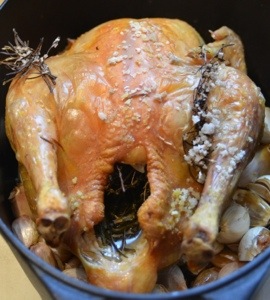
I’m warning you right now, that this is by far the juiciest and most flavorful chicken you’ll ever put in your mouth, so unless you’re willing to cook this on a regular basis, don’t do it.

20130723-124017.jpg

CHICKEN WITH 40 CLOVES OF GARLIC
(as per mom’s recipe)
– 1 capon or large roasting chicken
– a few sprigs of fresh rosemary
– a few sprigs of fresh thyme
– a handful of fresh Italian parsley
– a handful of fresh basil
– 1 laurel leaf
– 1 fresh lemon, quartered
– 40 cloves of garlic, in their skin (approx. 4-5 bulbs)
– approx. ¼ cup of extra virgin olive oil
– salt & pepper, to taste
– 3 cups of flour, ½ cup of water & oil (for the seal)
– 1-2 tbsp of soft butter

Preheat oven to 350F. Rinse the chicken and pat dry, then salt & pepper the cavity. Take roughly about ¾ of all the fresh herbs, and stuff them in the cavity together with the fresh lemon. Rub salt & pepper on the outside and under the skin, and rub the chicken with a bit of butter.

Smash the bulbs of garlic on your counter top, and separate all the cloves. Remove the loose, rough outer leaves, but leave each clove in its own peel. Chop the remainder of the fresh herbs finely.

In a heavy large oven-proof & lidded pot (such as a Dutch oven), add the olive oil, fresh herbs and 40 cloves of garlic all at once, and stir/sauté for just a minute or two. Place chicken on top of the garlic & herbs.

Make a flexible yet firm dough from the flour, water & oil. Roll into a sausage and line it alongside the edge of your pot. Place the lid on top and gently press it down into the dough, creating a glue-effect. The idea is to seal the pot completely, so no air can escape whilst cooking… trapping all the flavors inside.

Place the pot in the middle of the oven, and cook for approx. 1 ½ to 2 hours, depending on the size of the chicken. For crispy skin, remove lid from pot (you’ll have to crack it open!) for the last ½ hour of cooking so the skin can brown a bit, however, doing so will allow all the delicious flavors to escape and mellow out a bit… I’m not a chicken-skin aficionado, so I usually don’t care about crispy skin and leave my pot closed. This will be your call, really.

When the chicken is done, take it out of the pot and scoop up the cloves of garlic that have now browned and caramelized in the chicken juices. You can quite literally squeeze them out of their peel, and use the sweet, caramelized flesh to mix into mashed potatoes or schmear directly on crusty slices of French bread. Bon appétit!

Serve with any vegetable you like, but ‘Confit Byaldi’ is a great accompaniment.