Brussels Sprouts with Pancetta & Shallots

12 Jul

Behold: spruitjes!

20130712-181532.jpg

Don’t hate! ‘Spruitjes’ are without a doubt the most misunderstood vegetable in this world. Their cabbagey deliciousness is completely under-appreciated, in my humble opinion. The problem with ‘spruitjes’ is that most people who label them the fruit of Satan, don’t buy them fresh. For purists like me, that’s strike #1. Worse yet, the misunderstood sweetlings are then dropped into a pot of salted water and boiled until there’s no sign of life left in them. Strike #2!

Spruitjes are truly delightful when cooked the right way. You simply *must* buy them fresh on the stalk, when they are still happily clinging to the mother ship. Slice them off individually with a sharp knife and remove all of the darker loose leaves. What you really want, is the lighter green darlings that are hiding behind those loose outer leaves. Trim the fibrous bottom a bit, so you have a nice looking, handsome sprout. Et voila, you can hardly go wrong from here…
(As an added bonus, you’ll end up with a mighty green light saber when all of this is done, not that we ever indulge in anything Star Trek in this house)
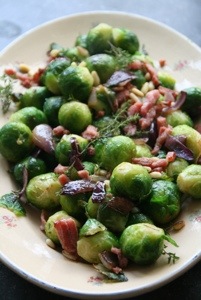
20130712-194806.jpg

BRUSSELS SPROUTS WITH PANCETTA AND SHALLOTS
(in the manner of The Hungry Belgian)
– 2.5 lbs of Brussels sprouts (+/- 1 large stalk)
– 1/4 lbs of pancetta, cubed into fine dice
– 1 shallot, finely diced
– 4-5 sprigs of fresh thyme, chopped
– 2 tbsp of butter
– juice of 1/2 lemon
– salt & pepper, to your liking

Slice the little cabbages off the stalk as listed above. Take the cleaned & trimmed fresh sprouts, and slice each one in half or in quarters, depending on the size. You can also leave them whole, it’s up to you.

Chop the fresh thyme finely.

In a heavy pan, such as cast iron, cook the pancetta until beginning to brown. Remove and set aside. Melt butter in the remaining pan drippings and cook shallot until softened and translucent. Add sprouts and cook over medium heat for approx. 6-7 min, until they are bright green, beginning to brown and somewhat soft. You want your spruitjes to still have some ‘bite’!
Add 2/3 of the chopped fresh thyme and pancetta back in the pan, stir and cook for an additional 1-2 minutes. Season with salt & pepper to your liking, and sprinkle fresh lemon juice & remaining fresh thyme over the top.

Please don’t hate. Try these, they’re delicious!

Belgo-American Beef Tartare

9 Jul

Literally translated, ‘Filet Américain’ means American Filet of Beef. But don’t be fooled. Filet Américain is not ‘just’ filet of beef, it’s tender raw beef that has been minced or ground very finely, blended with a delectable selection of spices, and bound into a heaping mush of savory deliciousness with mayo and egg yolks.

There you have it, my American friends. Before you collectively shout ‘FOUL!!’ and bombard me with various FDA warnings about eating raw beef and eggs, please allow me to ease your anxiety and assure you that I was spoon-fed Filet Américain from the moment I grew teeth, and live to tell about it… I’m not alone either. Millions of Belgians feast on Filet Américain every day. It’s practically written into our Constitution… thou shalt eat Filet Américain on thy lunch bread every day! It’s a National staple. A cornerstone in the Belgian lunch food pyramid.

Served atop crusty bread and topped with capers, pickled gherkins (‘cornichons’) or diced raw onions, it’s like the Cadillac of all beef tartare.

20140617-182655-66415731.jpg

FILET AMÉRICAIN
– 8 oz of very lean beef (*)
– 3 tbsp of ‘Kewpie’ mayo (**)
– 2 tsp of mustard (see homemade mustard here)
– 1 egg yolk
– 1 tsp of paprika powder
– ½ tsp of salt
– ½ tsp of black pepper
– ¼ tsp of sweet curry powder
– 10 drops of Worcestershire sauce
– pinch of cayenne, to taste

(*) buy good quality beef, as beef is the star in this recipe. It doesn’t have to be an expensive cut of beef, but it needs to be extra lean and preferably ‘prime’. I use beef eye round.
(**) Kewpie mayo is a Japanese mayo that is richer, more yellow and more ‘sour’ than regular mayo. If you can’t find it, use regular mayo and add a few drops of lemon juice

In a food processor, mince all ingredients together until a nice, even consistency forms. You want a gooey looking spread. Et voilà, you’re done.

If you don’t own a food processor, like me, select a piece of beef you like and ask your butcher to grind it fresh for you. They do this without any qualms at my grocery store. You can also buy extra lean pre-ground beef, but freshly ground beef takes the cake, as who knows when exactly that package of ground beef was actually ground?! Right?

Whisk the egg yolk, mustard and mayo together. In a bowl, add whisked eggs, mayo & mustard to the beef and blend well. Add all spices and Worcestershire sauce in the beef mixture, and combine until a smooth even consistency forms. Season with salt & pepper to taste, and add some cayenne pepper to your liking.

Spread this on top of your bread of choice. Top with capers, little pickled cocktail onions or diced raw onions… and prepare to go to beef heaven.

** In the unlikely event you have leftovers, you should know that this recipe should be stored in an airtight container in the fridge for up to max. 48 hours only.

Rub with Love.

9 Jul

It’s people like Tom Douglas that make me want to move to Seattle.  And then there’s also Berry & Glynis and the kids in their cute little ‘Twin Peaks’ town, crisp fresh air, mysterious deep blue waters, Pike Place Market, majestic pine trees, wild caught seafood, crabs galore, romantic ferries to gorgeous Puget Sound islands, creaky wooden boardwalks that line pebble beaches, wild blackberries for the picking (Glynis, I know. ‘Weeds’. Gah!)… but I digress.

If you haven’t tried Tom Douglas’ ‘Rub with Love’ line of spiced rubs, you simply must do it now. You’re missing the grilling soul train if you don’t, really. They’re a bit harder to find outside of the Pacific Northwest, but you can easily order any of the 16 flavors (SIXTEEN, y’all!) directly on Tom’s website.

rub with love - salmon 1

Twisted Mashed Potatoes (Stoemp)

8 Jul

If there was one thing my brother & loved when we were kids, it was ‘stoemp’. Mom would make it quite often, as we lived on a single-mom budget, and it’s one of those dishes that pack a ton of deliciousness on a few pennies.

Stoemp (pronounced ‘stoomp’) is a delightful mash of creamy potatoes and any vegetable your kids will eat you fancy that can be mashed with the potatoes. It’s often prepared with carrots in Belgium, and served alongside juicy browned sausage, with the buttery pan drippings drizzled over the mash. It’s pure awesomeness, believe me.

Now that I’ve outgrown my ‘Bunny & Friends’ dinner set, I still enjoy a good potato-vegetable mash. Not only is it a bit lighter and healthier, I feel that it gives plain ole mashed potatoes a more interesting flavor. It’s ‘feel good’ comfort food without fearing the immediate expansion of your hips.

20130708-210354.jpg
CAULIFLOWER, LEEK & FENNEL MASH
(makes enough to feed a family of 6… or your husband)

– 1.5 lbs of yellow potatoes
– 1 medium size head of cauliflower
– 3 leeks, sliced thinly
– 1 medium fennel bulb, very finely diced
– 3-4 tbsp of butter
– 1/3 cup of fresh thyme leaves
– salt & pepper to taste
– Pecorino-Romano cheese, grated (for topping, optional)

Cut cauliflower and pull florets apart. Discard outer green leaves and rough stems. Soak florets in a bath of salty water for a few minutes, to entice all bug friends to vacate the cauliflower NOW. Cut potatoes into chunks, roughly about the same size as the cauliflower florets so they cook evenly. Put potatoes and cauliflower into a large pot, and bring to a boil. Simmer until done and easily mashed.

In the meantime. Cut the dark green tops off of the leeks, and slice off bottom root. Slit each stalk in half lengthwise and rinse under cold running water, separating the layers a bit, to remove any dirt. Dry stalks with paper towels, and slice them into thin rings or strips.
Cut green stems, top and bottom root off of the fennel. Slice bulb into thick slices and finely dice each slice into small pieces like you would an onion.

Melt 1 tbsp of butter in a pan and sauté fennel over medium-low heat. When fennel is starting to soften (+/- 4-5 min), add leeks and continue to sauté until vegetables are soft, slightly browned and caramelized.
Sprinkle thyme leaves over vegetables, and sauté an additional 2 minutes to release the flavor of the thyme.

Mash cauliflower and potatoes with 2-3 tbsp of butter, add leek & fennel mixture, 1 clove of minced garlic and salt & pepper to your liking. Use a wooden spatula to combine everything together.

Sprinkle some grated Pecorino-Romano cheese & thyme leaves over the top and serve hot.

Moroccan Spiced Meatloaf

8 Jul

I love the warmth and intense flavors you find in most ethnic cuisines. There’s something really homey about the scent of cinnamon, cardamom and cumin.

When I lived in Belgium, my humble 3-story house (commonly referred to as ‘the shoebox’ by a good friend of mine) stood in the beating heart of the Moroccan neighborhood in Ghent. Even though it’s been well over a decade since I called the ‘Jasmijnstraat’ my home, the inviting scent of that neighborhood is engraved into my olfactory system. I still remember stepping off the crowded tram after a long day’s work, and being greeted by the smell of roasted spiced meats and freshly baked sesame breads. I would often take the tram 1-2 blocks further, just so I could walk the extra few blocks home and pass by all the Moroccan bakeries & grocers. I loved that neighborhood. I’ve met some of the friendliest people there.

Even though our language-gap was roughly the size of the Mediterranean, my neighbors ‘Faisal & Mohammed’ welcomed me with traditional Moroccan hospitality when I moved into the neighborhood: mint tea & baklava. I didn’t catch on until much later that Faisal actually did not speak any Dutch and only spoke very broken French, but we shared a love for great home-cooked food. We frequently found common ground at the local spice vendors & small fresh produce markets, where she would often point and smile at me to indicate what the best flavor deal of the day was. As time went on, she would regularly send over her jeans-clad kids with dishes that were so delicious, that I may or may not have licked them clean. I plead the fifth.

Faisal & Mohammed, while very traditional in their Moroccan culture, loved & embraced Western culture, and married the best of both worlds. The recipe below is adapted from Faisal’s take on meatloaf. Don’t be alarmed by all the spices, it makes for a delicious meatloaf!

spiced meatloaf

MORROCAN SPICED MEATLOAF – served approx. 6 people
(adapted from a recipe by my former neighbor Faisal)

– 2 tbsp of olive oil
– 1 medium-sized carrot, grated
– 1 large rib of celery, diced very finely
– 6 green onions
– 1 clove of garlic, minced
– 1 lbs of lean ground beef
– ½ lbs of ground pork (or add ground lamb or more beef instead of pork )
– 1 tsp of salt
– a dash of cayenne pepper
– ¼ tsp of black pepper
– 1 ½ tsp of ground cardamom
– ½ tsp of ground cumin
– ½ tsp of ground cinnamon
– ¼ tsp of mace
– ¼ tsp of ground ginger
– 1 cup of breadcrumbs
– 1 large egg, whisked
– ¼ cup of milk
– 1 cup of curry ketchup, divided (for a basic homemade curry ketchup recipe, look here)

Heat the oven to 350F. Lightly grease a 9x5x3 loaf pan. In a skillet or saucepan, melt the butter with the olive oil. Sauté the grated carrot and the celery until softened. Add green onions and garlic and sauté for 1 minute longer. Let cool slightly.

In a large bowl with hands, thoroughly combine the beef, pork, salt, peppers, spices, bread crumbs, egg, 1/2 cup of ketchup, and the milk. Stir in the sautéed vegetables until well blended.

Pack into the prepared loaf pan and bake for 1 hour. Spread the remaining 3 tablespoons of ketchup over the top of the loaf and bake for 15 minutes longer. Let rest for 5 minutes before slicing.

Gentse Waterzooi (chicken stew from Ghent)

6 Jul

If chicken ‘n dumplings had a Belgian cousin, it would surely be “waterzooi”. While waterzooi doesn’t come with puffy buttermilk dumplings, it ranks just a high on the creamy comfort food scale. Once you sop a piece of crusty French bread in its yolky broth, you’ll understand why this dish became a National treasure.

Translated from Dutch, ‘waterzooi’ means ‘to simmer in water’… The dish was historically nothing fancier than a simple fish boil with readily available fish like cod & perch, and potatoes. As rivers and ponds became more polluted and fish populations diminished, chicken made its debut in this classic charmer.

Today, the city of Ghent reigns unchallenged in waterzooi-land. Located in the Northwest corner of Belgium and only a short drive away from the North Sea, Ghent has placed waterzooi on the culinary map. Hundreds of restaurants each boast their own variation of the dish, all vying for the attention of the oodles of tourists that roam this picturesque city in search of waterzooi.

20130707-092247.jpg

GENTSE WATERZOOI
(Adapted from a recipe by ‘Restaurant De Karmeliet’)

– 1 whole chicken, quartered
– 3 stalks of celery
– 1 leek
– 3 carrots
– 6 firm potatoes (like Yukon Gold)
– 1 bunch of parsley
– 2-3 sprigs of thyme, leaves only
– 2 eggs
– 1 cup of heavy whipping cream
– 6-8 cups of chicken stock
– 2 tbsp of butter
– salt & pepper, to taste

Heat chicken stock and add chicken, let simmer for approx. 20-30 min on a low-medium fire until the chicken is done. Set aside.

Cut celery, carrot and leek into very fine strips (‘julienne’). Dice potatoes into rough chunks.
Take a large enough pan so all the broth and chicken will eventually fit, and sauté the vegetables and the potatoes in 1-2 tbsp of butter over medium heat.

In the meantime, take chicken out of the stock and peel off the skin, discard the skin.

Add peeled chicken to the vegetables & potatoes. Sift the stock to eliminate any impurities the chicken left behind, and add to pot with chicken, vegetables and potatoes.

Add 2/3 of the cream into the pot, and simmer another 10-15 min. Season with salt & pepper, to your liking.

In a separate bowl, add remaining cream and 2 egg yolks. Whisk together and gently add a bit of the hot broth one spoon at a time. This is called ‘tempering’. Keep whisking as you introduce the broth, to make sure your egg mixture won’t scramble. Keep adding broth until you reach a warm temperature. When the egg mixture is warm, take pot off the stove and gently drizzle and stir the egg mixture in the pot.

Ladle in shallow soup bowls, and sprinkle chopped parsley & thyme leaves over the top. Make sure to serve some French bread on the side, as the broth will have you yearning for more!

Wickedly Zesty Pickled Peppers

6 Jul

A few weeks ago, I came across food porn an inviting recipe from Deb Perlman at Smitten Kitchen for pickled vegetables. It looked so colorful and beckoning. In my giddy foodie enthusiasm, I sent it to my good friend Jolene, who would sell her left kidney for a pickle , and I pledged to make it that day. And then I forgot about it. Until today, when I noticed that a handful of bell peppers in my refrigerator had sadly abandoned the freshness club.

As I mentioned in my homemade mustard post earlier, something pickled of any sort makes a frequent appearance on any Belgian farmer’s table. Pickles are often served alongside cubes of farmers’ cheese (boerekaas) or Gouda, pâté, hunks of grainy brown bread and a Trappist beer. So when I stumbled upon Deb’s pickled vegetable recipe, it spoke seductively to my Belgian heart. There’s something magical that happens to your tastebuds when vinegary crunch and Gouda meet.

Deb’s recipe is a winner ‘as is’, but I didn’t have all the vegetables on hand and I also wasn’t particularly enthused by the idea of pickled sugar snap peas. In short, I took her recipe and ran with it… I added a few extra flavor components, like fennel seed and crushed red peppers for extra wickedness, and added a red onion & some garlic for oomph.

photo

WICKEDLY ZESTY PICKLED PEPPERS – makes approx. two 16oz jars.
(Adapted from a recipe by Smitten Kitchen)

– 1 red bell pepper
– 1 yellow bell pepper
– 1 orange bell pepper
– 1/2 of a red onion
– 1 large carrot
– 2 whole cloves of garlic
– 1 cup of distilled white vinegar
– 4 tbsp of white sugar
– 2 tbsp of salt
– 1/2 tbsp of fennel seed
– 1 tbsp of yellow mustard seed
– 1 tbsp of black pepper corns
– 1/2 tbsp of celery seed
– 1-2 tbsp of crushed red pepper, depending on how much bite you prefer.

“Julienne” all vegetables (except cloves of garlic) and set aside. If you have a mandolin slicer with a julienne blade, great! If you don’t have a mandolin slicer, try to finely slice your vegetables into thin strips as even in size as possible. (* if your mandolin is as angry as mine is, you may want to keep some band aids around)

In a small non-reactive sauce pan, heat vinegar, sugar, salt and all spices until sugar & salt dissolve only. Add water and stir. Let cool to lukewarm.

Place 1 clove of garlic in each glass (or non-reactive) jar.Divide sliced vegetables over jars, and gently pour vinegar mixture over the vegetables until completely submerged. You want to make sure the spices are more or less evenly divided over each jar as well.
Put the jars in the fridge and let the pickling feast begin. They will be pleasantly zesty in about 2 hours, and will continue to pickle a bit more over time. However, the flavor won’t change much from the first 2-4 hours of pickling. Provided you keep the peppers submerged in the vinegar at all times, they should last in your fridge for about 1 month.

Flemish Beef Stew (Stoverij)

5 Jul

‘Stoverij’ or Flemish beef stew is Belgium’s response to chili cheese fries. It’s hearty, stick-on-your-ribs food that feels like a warm hug on a cold winter’s day. “…but it’s Summer?!”, you say, well nothing screams Summer more than fries & stoverij from ‘t frietkot!

Belgian towns are dotted with small food stalls (think: semi-permanent ‘food truck’) that sell French fries and all the accompaniments: curry wurst (frikandel), meatballs (boullette), fried spring rolls (loempia), shrimp or chicken croquettes (garnaal of kippekroket), and of course the traditional Flemish beef stew (stoverij or stoofvlees). You know you’re in for a treat at your local “frietkot”, the minute you smell the frietjes (fries) baking in bubbling hot oil, filling the air with giddy anticipation of that first bite of fried food heaven.

Next to “frietjes”, beer is king in Belgium. Belgians learn how to cook with beer the minute they’re old enough to hold a ladle. It’s a rite of passage. After all, with over 71 different types of beer brewed and 350+ house labels to choose from, it’s the national drink of choice. When I left Ghent in late 1999, the country that is roughly the size of Rhode Island boasted 18 actively operated ‘national’ breweries and a few dozen local artisanal breweries for good measure. As I recall, pretty much every village had at least one ‘Trappist’ or ‘Catholic Benedict’ abbey where one could purchase abbey-brewed beer directly from the monks themselves. They each created their own flavor pallet, using age old brewing methods passed on for decades. The trifecta of beer-cheese-bread has long been an abbey’s bread & butter, so to speak.

Flemish beef stew is traditionally served over hot & crispy French fries, but it’s equally as delectable with a few torn hunks of grainy bread. The meat is so tender and the sauce is so sweet, you’ll come back for seconds… and thirds. Just don’t forget to enjoy a nice full-bodied beer with it, it’s practically a mortal sin if you don’t.

20130705-195422.jpg

FLEMISH BEER STEW or ‘Stoverij’
(adapted from a recipe by Piet Huysentruyt)

– 2 to 2.5 lbs of stew meat (I prefer chuck shoulder meat)
– 2 large onions, cut in half and sliced into not-so-thin strips
– 16oz of dark beer, more or less
– 2 tbsp of dark brown sugar, heaping (or ¼ cup of molasses)
– 1 whole clove
– 1 small clove of garlic, minced
– 2 laurel leaves
– 3-4 sprigs of rosemary
– 2-3 sprigs of thyme
– 1-2 slices of brown bread, liberally spread with 2 tbsp of mustard
– a splash of balsamic vinegar
– a few tbsp of olive oil
– 1-2 tbsp of butter
– salt & pepper to taste

1. Take a small piece of cheese cloth and tie the rosemary, thyme & cloves in. You’ll want to be able to remove it from the stew easily later on.

2. Cut the meat in roughly 1-inch size cubes. Salt & pepper like you would a steak.

3. In a large Dutch oven, heat the olive oil and brown the meat over medium heat. It’s best to do this in batches, as you don’t want to overcrowd the meat. Overcrowding means the meat won’t brown, it’ll rather steam and you don’t want this. You want a nice crispy brown edge on each piece of meat. Set each batch of meat aside. Don’t be alarmed by the brownish ‘crud’ that forms on the bottom of your pan, and definitely don’t try to get rid of it… This is where a lot of the flavor forms.

4. When all meat is browned, turn up the heat a bit and pour a splash or two of the beer in the pan. Scrape the bottom of your pan to loosen the browned bits the meat formed.

5. When most of the bits are loosened and starting to dissolve in the beer, add the butter and the sliced onions & minced garlic, and continue to cook until the onions are turning translucent.

6. Add the remainder of the beer, browned beef, cheese cloth with herbs and the sugar, and cook over low heat for 2-3 hours until the beef is fork tender. Place slices of mustard covered bread on top of the simmering stew. They’ll slowly dissolve and thicken the stew some.

7. Keep the lid off of your pot. Once you have reached the desired thickness of the sauce, only then place the lid on the pot.

8. when the stew is ready, remove the cheese cloth wrapped herbs and laurel leaves, add a splash of balsamic vinegar and stir.

Enjoy!

Omoe Jozefa’s homemade mustard

5 Jul

Since I posted a recipe for homemade ketchup yesterday, it’s only befitting that I would post one for mustard today. After all, ketchup & mustard belong together like Siegfried & Roy. Seperate them, and – well – things are just not right.

While it’s not a Belgian invention, mustard is another one of those Belgian staples. It’s served alongside everything. If you hail from a small Flemish country town like I do, you surely remember the annual Summer ‘Breugel Feesten’ where you are traditionally presented with a plate of diced gouda & paté of pheasant or wild boar, served alongside a bowl of zesty ‘cornichons & ajuintjes’, tiny little pickled dill gerkins & onions… all to be washed down with a nice dark Leffe ‘van ‘t vat’ (Leffe beer on tap).

Mustard is ridiculously easy to make, albeit a bit time consuming as it requires some planning ahead. You’ll find many mustard recipes online, but the basic recipe below comes from my very own grandma Jozefa, bless her soul. She made sure that I understood the importance of using non-reactive utensils and unsuccesfully taught me the virtue of being patient. Mustard is really nothing more than a combination of ground (or powdered) mustard seed and some sort of liquid, blended together with any flavorings you fancy.

There’s a few tips I can pass along to you:

  • For a spicy and flavorful mustard, always use a combination of yellow, brown and/or black mustard seed. Yellow seed is fairly mild and – when used alone – typically yield a ‘flat’ or very mild mustard. For a bolder flavor, you need to add some black mustard seed.
  • To change the flavor, experiment by swapping liquids (beer, champagne, white wine…) and adding additional flavorings (tarragon leaves, honey…)
  • When adding the liquids to the ground mustard seed, the temperature of the liquid makes a difference too: hot liquids yield a more mild mustard whereas cold liquids give it more kick or bite.
  • The longer mustard ‘sits’, the milder it gets. Don’t be alarmed if your mustard tastes too spicy right after you made it, it’ll definitely ‘calm down’ in a few days to a week.

HOMEMADE MUSTARD – THE BASICS  (yields approx. 5oz of mustard)
– 2oz of mustard seed (I use even quantities of yellow, black & red or brown mustard seed)
– 3.5 fl oz of white wine vinegar (or champagne vinegar)
– 3.5 fl oz of water
– pinch of salt, to your liking
– pinch of sugar or 1 tsp of honey, if you like your mustard a bit sweet

Place the mustard seed in an airtight glass (or non-reactive) jar with the water and vinegar. Shake well and let sit for 24-48 hours.
In a food processor (or with mortar & pestle), pulverize the soaked seeds until you get a nice creamy paste. This takes a bit of time, so be patient. For a more grainy mustard, blend less. For a creamier mustard, keep on blending until you achieve the desired creaminess. Add a bit more water one tbsp at a time if it all turns out a bit too grainy and dry. Also, homemade mustard is not quite as ‘yellow’ in color as store-bought mustard. If you fancy that yellow color, add a dash of kurkuma for color.

BEER-THYME MUSTARD
Use basic recipe above, but replace water & vinegar with 4.5oz of full-bodied red or amber ale (or stout), and 2.5oz of champagne vinegar. Once blended, add 1-2 tsp of finely chopped fresh thyme leaves.

HONEY-DILL MUSTARD
Use basic recipe above. When the mustard is blended to your desired creaminess, add a 1-2 tbsp of honey and a whopping tbsp of chopped dill.

LEMON-TARRAGON MUSTARD
Use basic recipe above. When blended, add 1-2 tsp of fresh lemon zest and 1 tbsp of finely chopped fresh tarragon leaves

ROSEMARY MUSTARD
Use basic recipe above. When blended, add 2 tbsp of very finely chopped fresh rosemary leaves

Homemade mustard lasts approx. 1 month in an airtight container in your refrigerator. Before using, allow it to sit for approx. 5 days so the ‘fire’ dies down a bit and the flavors have a chance to blend together.

Homemade Curry Ketchup

4 Jul

With grilling season wide open, I can’t thank my foodie friend Debi at Life Currents enough for posting her delicious homemade ketchup recipe. Debi, seriously girlfriend, I bow to your culinary genius.

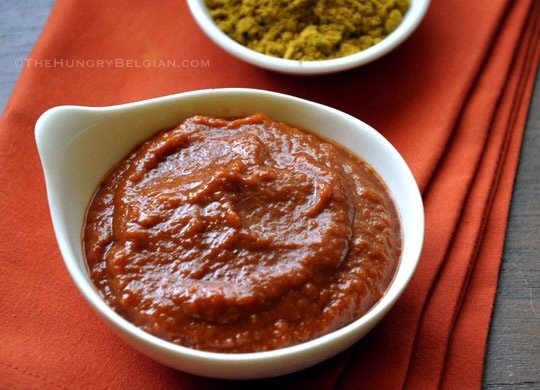
Now, I wouldn’t be a full-blooded Belgian, if I didn’t turn this saucy deliciousness into an authentic Belgian staple: curry ketchup. It’s one of those things that I was forced to abandon when I came to America… Or so I thought. Nothing screams Belgium more than a good old paper cone baggie of crispy hot fries, accompanied by a zesty curry wurst (frikandel) with freshly diced onions and curry ketchup. It’s how we roll in Belgium.

20140614-123526-45326000.jpg

HOMEMADE CURRY KETCHUP
(adapted from a recipe by Life Currents)

– 1 6oz can of tomato paste
– 1/4 cup of water
– 1/4 cup of white vinegar
– 1/4 cup of blue agave syrup (or honey)
– 1/2 tsp of brown sugar
– 1 tsp of sweet curry powder
– 1/2 tsp of cayenne pepper
– 1/4 tsp of onion powder
– 1/8 tsp of garlic powder
– 1/4 tsp of salt

In a medium sauce pan, combine all ingredients and bring to a boil. Turn heat to low and simmer for 10-15 min. Let cool and store in an airtight container in the fridge.
For regular ketchup, omit the curry and cayenne pepper, an “up” the brown sugar to 1tsp, instead of 1/2 tsp… or head on over to Life Currents!