Tag Archives: vegetarian

Piperade Basquaise

17 Jul

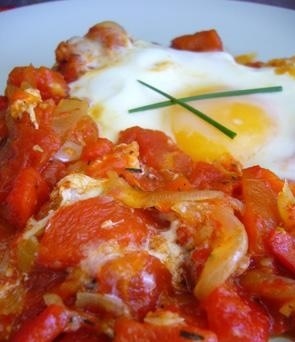
Traditionally from the rural Basque regions in Spain & Southern France, I decided that something as delicious as ‘Piperade’ must be honored on this blog. There’s no tie to Belgian cuisine, other than the fairly mundane fact that I ate this in my mom’s country kitchen in our small Flemish country town, surrounded by smelly dairy farms, swarms of potato bugs, cackling poultry and endless corn fields.

Piperade fits right in this pretty farmers picture. It’s a flavorful and hearty dish that won’t break the bank… unless you live in coastal Los Angeles, but let’s not be cynical about living a mile away from the Pacific Ocean, shall we? In Spain and the South of France, piperade is often accompanied by cubes of grilled Bayonne ham and silky poached eggs, and served alongside hand-torn morsels of brown country bread to sop up the culinary orgasm that is runny yolks blended with ham- and sweet pepper juices. I feel bashful just writing about it.

Since Bayonne ham is not readily available in my coastal settlement, I would probably have to drive all the way to smog city downtown LA in order to score some authentic Basque ham. And trust me when I say that no ham is worth fighting 405 freeway traffic for!

This leads me to tell you that since Bayonne ham has a light smoky flavor, I figured I’d try my luck with pancetta, and… BINGO! I think bacon would work well too, or surely even diced smoked kielbasa. In fact, this is such a versatile dish, that you could completely omit the meat and go vegetarian altogether. Or serve it alongside or on top of crispy browned chicken legs, which I vaguely remember is what my mother did.
20130717-193244.jpg
PIPERADE BASQUAISE
(adapted from multiple recipes I found online)
– 1 medium size red bell pepper
– 1 medium size yellow bell pepper
– 1 medium size orange bell pepper
– 2 medium size onions
– 1/4 cup of extra virgin olive oil
– 6 cloves of garlic, minced
– 1 tsp of Piment d’Espelette (*)
– 1/2 tsp of chopped fresh oregano
– 1 tsp of chopped fresh thyme
– 1 cup of diced pancetta
– 4 large fresh eggs
(*) Piment d’Espelette is a medium hot chili that comes from the Basque town of Espelette. You can find it in specialty food stores, but you can also replace it with hot paprika if you can’t find it.

Cut peppers in half lengthwise, seed, core and slice into thin strips. Cut onions in half and slice into thin strips as well. Mince garlic cloves.

Heat oil in a large heavy pan and sauté garlic and onions until beginning to soften, approx. 3-4 min. Add peppers and sauté until beginning to soften, approx. 5 min. Add bay leaves, piment d’espelette and fresh oregano, and simmer over low heat until vegetables are soft.

In the meantime, dice pancetta and brown in a separate pan. When browned, set aside on paper towel. Deglaze pan with a bit of white wine, and add pan juices to vegetables.

When vegetables are soft, add pancetta & fresh thyme to pan and simmer 3 min more to blend all flavors. Salt & pepper to taste.

Make 4 small spaces in your pan, among the pepper mixture, and drop a raw egg in each space. Turn heat to low, cover and allow egg to cook for 3-4 min until whites are done and yolks are a bit runny still. This will take a little while, so patience is key here. (You can also poach your eggs separately, and serve over the piperade).

Sprinkle with some fresh parsley and serve with crusty brown bread, or over couscous.
Soledad Goat Cheese

16 Jul

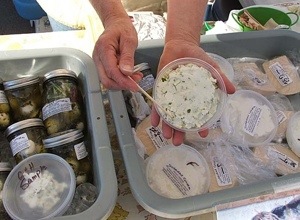
I have a confession to make. I just ate lemon-lavender goat cheese for dessert. Straight from the jar. What kind of goat cheese can conceivably be conceptualized as a dessert by taste buds? This kind.

At $6.00 a tub, I used to think Soledad goat cheese was way too expensive, until they roped me in with a sample one day. Ever since that moment, I’ve had pear-walnut-honey goat cheese on raisin toast for breakfast, onion-cucumber goat cheese on rye for lunch, roasted sweet pepper goat cheese stuffed in figs for a snack, regular goat cheese on beet salads, lemon-lavender goat cheese as dessert… Oh dear Lord, help me.

I’m sorry if you live out of Los Angeles County lines, because that means you will likely not be able to drift off into goat cheese nirvana until your next vacation. However, next time you plan a visit, make sure to pencil in a stop at any of our local farmers markets and pick up a tub of their goat cheese.

Apart from making great cheese, the folks at Soledad Goat Farms love their goats. Loved goats give great milk. It’s a happy place.

20130716-195022.jpg

20130716-195050.jpg

Rémy’s Ratatouille (Rat-a-too-ee)

16 Jul

So…how many of you saw the title and instantly wandered off to romantic Paris in their mind, with its cobble-stoned rues and fresh baguettes? Right? A few Christmases ago, my sweetheart surprised me with Pixar’s ‘Ratatouille’, and I instantly fell in love with it for more reasons than just the adorable rat Rémy and the equally as lovable man who gave me the movie in the first place. I loved it because it teaches us a very simple but important lesson in life: no matter who you are or where you come from, there’s always something wonderful around the corner when you follow your passion. Aw.

Now the thing is, there’s nothing even remotely Belgian about ratatouille. It’s a dish straight out of French cuisine, Provence to be precise. As children, my brother & I spent many Summer vacations in our family’s sweltering caravan, on a dusty campground at the Cote d’Azur. How lucky were we?
Ratatouille is reminiscent of the flavors of my childhood vacations, so it has a special place in my heart, right next to the smell of gasoline and roasted salty & sweet peanuts. Don’t ask.

Rémy didn’t actually cook ‘ratatouille’ as his showcase dish for Mr. Anton Ego, the austere & disdainful food critic in the movie. No. Rémy cooked ‘Confit Byaldi’.

While similar in flavor, Confit Byaldi is the more elegant version of its often too soggy & overcooked Provençal cousin ratatouille. Visually stunning, Confit Byaldi tempts with caramelized layers of equal size slices of zucchini, yellow squash, Japanese eggplant & roma tomatoes, all resting happily on a bed of piperade sauce. Doesn’t that sound sexy already? And with all these gorgeous Summer vegetables making a happy appearance at your local farmers’ market right now, the timing couldn’t be better.

20130719-184701.jpg

CONFIT BYALDI
(adapted from Thomas Keller)

For the Piperade sauce:
– 1/2 red bell pepper, seeds & ribs removed, finely diced
– 1/2 yellow bell pepper, seeds & ribs removed, finely diced
– 1/2 of orange bell pepper, seeds & ribs removed, finely diced
– 1 small clove of garlic, minced (+/- 1 tsp)
– 2-3 tbsp of extra virgin olive oil
– 1.5 cups of crushed tomatoes
– 1 small onion, finely diced
– 2 sprigs of fresh thyme, left whole
– salt & pepper
– 1 bay leaf

Heat olive oil in a pan and sauté onion & garlic over medium-low heat until onions are soft but not browned, +/- 8 minutes. Add crushed tomatoes, thyme & bay leaf, and simmer until everything is very soft and very little liquid remains, about 10 minutes. Add peppers and simmer until soft, another 8-10 minutes or so. Discard bay leaf & thyme, season with salt & pepper.

For the vegetables:
– 1 zucchini (4 to 5 ounces) sliced in 1/16-inch rounds
– 1 Japanese eggplant, (4 to 5 ounces) sliced into 1/16-inch rounds
– 1 yellow squash (4 to 5 ounces) sliced into 1/16-inch rounds
– 4 Roma tomatoes, sliced into 1/16-inch rounds
– 1 small red onion, sliced thinly but make sure rounds stay together and don’t fall apart
– 1 red bell pepper, thinly sliced in rounds
– 1 tsp minced garlic
– 2 tsp of extra-virgin olive oil
– 1 tsp of chopped fresh thyme leaves
– 1/2 cup of sliced black olives (if you hate olives, you can totally leave them out. No big deal)
– salt and pepper, to taste

(*) I use a mandolin to slice my thumbnail all vegetables nice & evenly, but you can definitely do this by hand as well. Just make sure all slices are even in size.

Spread piperade sauce on the bottom of an oven-proof pan. Heat oven to 250F degrees.
Arrange alternating vegetables in a close spiral, so that 1/4 of each slice of vegetable sticks out. Repeat until pan is filled and all (or most) of the vegetables are used.

Mix garlic, oil, and thyme leaves in bowl and season with salt and pepper to taste. Sprinkle over vegetables.

Cover the pan with foil and seal well. Bake until vegetables are tender, about 2 hours. Uncover, turn oven to 400F and bake for 30 minutes more, or until the dish is slightly browned and liquid has mostly evaporated.
Take out of the oven and sprinkle olives and fresh thyme over the top.

I typically serve this over couscous or brown rice, barley… You name it. Chicken or fish are great with this dish as well.

Homemade Nutella

13 Jul

If Belgium’s contribution to world peace & happiness is chocolate, than surely Italy’s is Nutella.

Pietro Ferrero, the brilliant mind behind ‘crema giandujot’, invented a chocolatey hazelnut butter during WWII, when chocolate was scarce and the traditional European chocolate butters that his children adored were no longer available. Pietro, driven by his desire to preserve his children’s happiness during the war, created a deliciously nutty paste of finely ground hazelnuts, milk and chocolate… and so ‘gianduja’ was born. Later, Italian chocolatier Ferrero-Rocher started marketing Pietro’s recipe as ‘Nutella’, and the rest is history.

Filberts, aka hazelnuts, have long been on my friends’ list too. It’s no secret that Nutella and my double chin I have been tangled up in a love triangle since my sweet sixteenth. I finally swore off the stuff because – as a cruel act of nature – my hips would expand every time I even remotely glanced in the direction of something I liked sugary.

I thought it would be fun to try and recreate Nutella. However, browsing the Internet for a recipe quickly became a Herculean task. From Vegan to French, pretty much all recipes called for the elaborate task of roasting, peeling and grinding hazelnuts into a fine paste and combining that with molten milk chocolate. I happen to know that Italian ‘gianduja’ is made this way, so I figured I could skip this step and create my own recipe using gianduja instead… The texture is not quite as creamy as Nutella, but the flavor is really close, in my opinion. You should be able to find the ingredients at your local specialty kitchen supply or baking store, or you can order most of it from Surfas online.
(*) if you decide to make your own gianduja, blend 1 cup of roasted & peeled hazelnuts with approx. 7 oz of melted milk chocolate and 1tbsp of butter. You will need a professional strength food processor or a vitamix, in order to achieve a fine paste or butter that is not ‘gritty’. Pour mixture out on a plastic lined baking sheet using a candy mold, and allow it cool outside the fridge in a chill area of max. 65F until it sets. You can then dice it or cut it as you like.

20130713-140916.jpg

HOMEMADE NUTELLA
(recreated from various recipes on the Web)
– 3 oz of milk chocolate, chopped
– 1 oz of bitter dark chocolate, chopped
– 5 oz of pure gianduja chocolate, chopped
– 1 397gr. can of UNsweetened condensed/evaporated milk
– 1/4 cup of turbinado sugar (or brown cane sugar)
– 1/2 cup of heavy cream (or half & half)
– 1 tsp of pure hazelnut extract
– 1/2 tsp of pure vanilla extract
– 0.5 oz of cocoa butter (or 1/4 cup of coconut oil)
– pinch of salt

Warm condensed milk and cream over medium to low heat. Add chocolate & cocoa butter and sugar, and melt everything together until it’s well-combined. Add hazelnut & vanilla extract and stir to incorporate the flavor. Give it a pinch of salt to your liking, and pour into glass jars. Allow to cool & harden in the refrigerator for a few hours.

Rub with Love.

9 Jul

It’s people like Tom Douglas that make me want to move to Seattle.  And then there’s also Berry & Glynis and the kids in their cute little ‘Twin Peaks’ town, crisp fresh air, mysterious deep blue waters, Pike Place Market, majestic pine trees, wild caught seafood, crabs galore, romantic ferries to gorgeous Puget Sound islands, creaky wooden boardwalks that line pebble beaches, wild blackberries for the picking (Glynis, I know. ‘Weeds’. Gah!)… but I digress.

If you haven’t tried Tom Douglas’ ‘Rub with Love’ line of spiced rubs, you simply must do it now. You’re missing the grilling soul train if you don’t, really. They’re a bit harder to find outside of the Pacific Northwest, but you can easily order any of the 16 flavors (SIXTEEN, y’all!) directly on Tom’s website.

rub with love - salmon 1

Twisted Mashed Potatoes (Stoemp)

8 Jul

If there was one thing my brother & loved when we were kids, it was ‘stoemp’. Mom would make it quite often, as we lived on a single-mom budget, and it’s one of those dishes that pack a ton of deliciousness on a few pennies.

Stoemp (pronounced ‘stoomp’) is a delightful mash of creamy potatoes and any vegetable your kids will eat you fancy that can be mashed with the potatoes. It’s often prepared with carrots in Belgium, and served alongside juicy browned sausage, with the buttery pan drippings drizzled over the mash. It’s pure awesomeness, believe me.

Now that I’ve outgrown my ‘Bunny & Friends’ dinner set, I still enjoy a good potato-vegetable mash. Not only is it a bit lighter and healthier, I feel that it gives plain ole mashed potatoes a more interesting flavor. It’s ‘feel good’ comfort food without fearing the immediate expansion of your hips.

20130708-210354.jpg
CAULIFLOWER, LEEK & FENNEL MASH
(makes enough to feed a family of 6… or your husband)

– 1.5 lbs of yellow potatoes
– 1 medium size head of cauliflower
– 3 leeks, sliced thinly
– 1 medium fennel bulb, very finely diced
– 3-4 tbsp of butter
– 1/3 cup of fresh thyme leaves
– salt & pepper to taste
– Pecorino-Romano cheese, grated (for topping, optional)

Cut cauliflower and pull florets apart. Discard outer green leaves and rough stems. Soak florets in a bath of salty water for a few minutes, to entice all bug friends to vacate the cauliflower NOW. Cut potatoes into chunks, roughly about the same size as the cauliflower florets so they cook evenly. Put potatoes and cauliflower into a large pot, and bring to a boil. Simmer until done and easily mashed.

In the meantime. Cut the dark green tops off of the leeks, and slice off bottom root. Slit each stalk in half lengthwise and rinse under cold running water, separating the layers a bit, to remove any dirt. Dry stalks with paper towels, and slice them into thin rings or strips.
Cut green stems, top and bottom root off of the fennel. Slice bulb into thick slices and finely dice each slice into small pieces like you would an onion.

Melt 1 tbsp of butter in a pan and sauté fennel over medium-low heat. When fennel is starting to soften (+/- 4-5 min), add leeks and continue to sauté until vegetables are soft, slightly browned and caramelized.
Sprinkle thyme leaves over vegetables, and sauté an additional 2 minutes to release the flavor of the thyme.

Mash cauliflower and potatoes with 2-3 tbsp of butter, add leek & fennel mixture, 1 clove of minced garlic and salt & pepper to your liking. Use a wooden spatula to combine everything together.

Sprinkle some grated Pecorino-Romano cheese & thyme leaves over the top and serve hot.

Wickedly Zesty Pickled Peppers

6 Jul

A few weeks ago, I came across food porn an inviting recipe from Deb Perlman at Smitten Kitchen for pickled vegetables. It looked so colorful and beckoning. In my giddy foodie enthusiasm, I sent it to my good friend Jolene, who would sell her left kidney for a pickle , and I pledged to make it that day. And then I forgot about it. Until today, when I noticed that a handful of bell peppers in my refrigerator had sadly abandoned the freshness club.

As I mentioned in my homemade mustard post earlier, something pickled of any sort makes a frequent appearance on any Belgian farmer’s table. Pickles are often served alongside cubes of farmers’ cheese (boerekaas) or Gouda, pâté, hunks of grainy brown bread and a Trappist beer. So when I stumbled upon Deb’s pickled vegetable recipe, it spoke seductively to my Belgian heart. There’s something magical that happens to your tastebuds when vinegary crunch and Gouda meet.

Deb’s recipe is a winner ‘as is’, but I didn’t have all the vegetables on hand and I also wasn’t particularly enthused by the idea of pickled sugar snap peas. In short, I took her recipe and ran with it… I added a few extra flavor components, like fennel seed and crushed red peppers for extra wickedness, and added a red onion & some garlic for oomph.

photo

WICKEDLY ZESTY PICKLED PEPPERS – makes approx. two 16oz jars.
(Adapted from a recipe by Smitten Kitchen)

– 1 red bell pepper
– 1 yellow bell pepper
– 1 orange bell pepper
– 1/2 of a red onion
– 1 large carrot
– 2 whole cloves of garlic
– 1 cup of distilled white vinegar
– 4 tbsp of white sugar
– 2 tbsp of salt
– 1/2 tbsp of fennel seed
– 1 tbsp of yellow mustard seed
– 1 tbsp of black pepper corns
– 1/2 tbsp of celery seed
– 1-2 tbsp of crushed red pepper, depending on how much bite you prefer.

“Julienne” all vegetables (except cloves of garlic) and set aside. If you have a mandolin slicer with a julienne blade, great! If you don’t have a mandolin slicer, try to finely slice your vegetables into thin strips as even in size as possible. (* if your mandolin is as angry as mine is, you may want to keep some band aids around)

In a small non-reactive sauce pan, heat vinegar, sugar, salt and all spices until sugar & salt dissolve only. Add water and stir. Let cool to lukewarm.

Place 1 clove of garlic in each glass (or non-reactive) jar.Divide sliced vegetables over jars, and gently pour vinegar mixture over the vegetables until completely submerged. You want to make sure the spices are more or less evenly divided over each jar as well.
Put the jars in the fridge and let the pickling feast begin. They will be pleasantly zesty in about 2 hours, and will continue to pickle a bit more over time. However, the flavor won’t change much from the first 2-4 hours of pickling. Provided you keep the peppers submerged in the vinegar at all times, they should last in your fridge for about 1 month.

Omoe Jozefa’s homemade mustard

5 Jul

Since I posted a recipe for homemade ketchup yesterday, it’s only befitting that I would post one for mustard today. After all, ketchup & mustard belong together like Siegfried & Roy. Seperate them, and – well – things are just not right.

While it’s not a Belgian invention, mustard is another one of those Belgian staples. It’s served alongside everything. If you hail from a small Flemish country town like I do, you surely remember the annual Summer ‘Breugel Feesten’ where you are traditionally presented with a plate of diced gouda & paté of pheasant or wild boar, served alongside a bowl of zesty ‘cornichons & ajuintjes’, tiny little pickled dill gerkins & onions… all to be washed down with a nice dark Leffe ‘van ‘t vat’ (Leffe beer on tap).

Mustard is ridiculously easy to make, albeit a bit time consuming as it requires some planning ahead. You’ll find many mustard recipes online, but the basic recipe below comes from my very own grandma Jozefa, bless her soul. She made sure that I understood the importance of using non-reactive utensils and unsuccesfully taught me the virtue of being patient. Mustard is really nothing more than a combination of ground (or powdered) mustard seed and some sort of liquid, blended together with any flavorings you fancy.

There’s a few tips I can pass along to you:

  • For a spicy and flavorful mustard, always use a combination of yellow, brown and/or black mustard seed. Yellow seed is fairly mild and – when used alone – typically yield a ‘flat’ or very mild mustard. For a bolder flavor, you need to add some black mustard seed.
  • To change the flavor, experiment by swapping liquids (beer, champagne, white wine…) and adding additional flavorings (tarragon leaves, honey…)
  • When adding the liquids to the ground mustard seed, the temperature of the liquid makes a difference too: hot liquids yield a more mild mustard whereas cold liquids give it more kick or bite.
  • The longer mustard ‘sits’, the milder it gets. Don’t be alarmed if your mustard tastes too spicy right after you made it, it’ll definitely ‘calm down’ in a few days to a week.

HOMEMADE MUSTARD – THE BASICS  (yields approx. 5oz of mustard)
– 2oz of mustard seed (I use even quantities of yellow, black & red or brown mustard seed)
– 3.5 fl oz of white wine vinegar (or champagne vinegar)
– 3.5 fl oz of water
– pinch of salt, to your liking
– pinch of sugar or 1 tsp of honey, if you like your mustard a bit sweet

Place the mustard seed in an airtight glass (or non-reactive) jar with the water and vinegar. Shake well and let sit for 24-48 hours.
In a food processor (or with mortar & pestle), pulverize the soaked seeds until you get a nice creamy paste. This takes a bit of time, so be patient. For a more grainy mustard, blend less. For a creamier mustard, keep on blending until you achieve the desired creaminess. Add a bit more water one tbsp at a time if it all turns out a bit too grainy and dry. Also, homemade mustard is not quite as ‘yellow’ in color as store-bought mustard. If you fancy that yellow color, add a dash of kurkuma for color.

BEER-THYME MUSTARD
Use basic recipe above, but replace water & vinegar with 4.5oz of full-bodied red or amber ale (or stout), and 2.5oz of champagne vinegar. Once blended, add 1-2 tsp of finely chopped fresh thyme leaves.

HONEY-DILL MUSTARD
Use basic recipe above. When the mustard is blended to your desired creaminess, add a 1-2 tbsp of honey and a whopping tbsp of chopped dill.

LEMON-TARRAGON MUSTARD
Use basic recipe above. When blended, add 1-2 tsp of fresh lemon zest and 1 tbsp of finely chopped fresh tarragon leaves

ROSEMARY MUSTARD
Use basic recipe above. When blended, add 2 tbsp of very finely chopped fresh rosemary leaves

Homemade mustard lasts approx. 1 month in an airtight container in your refrigerator. Before using, allow it to sit for approx. 5 days so the ‘fire’ dies down a bit and the flavors have a chance to blend together.

Homemade Curry Ketchup

4 Jul

With grilling season wide open, I can’t thank my foodie friend Debi at Life Currents enough for posting her delicious homemade ketchup recipe. Debi, seriously girlfriend, I bow to your culinary genius.

Now, I wouldn’t be a full-blooded Belgian, if I didn’t turn this saucy deliciousness into an authentic Belgian staple: curry ketchup. It’s one of those things that I was forced to abandon when I came to America… Or so I thought. Nothing screams Belgium more than a good old paper cone baggie of crispy hot fries, accompanied by a zesty curry wurst (frikandel) with freshly diced onions and curry ketchup. It’s how we roll in Belgium.

20140614-123526-45326000.jpg

HOMEMADE CURRY KETCHUP
(adapted from a recipe by Life Currents)

– 1 6oz can of tomato paste
– 1/4 cup of water
– 1/4 cup of white vinegar
– 1/4 cup of blue agave syrup (or honey)
– 1/2 tsp of brown sugar
– 1 tsp of sweet curry powder
– 1/2 tsp of cayenne pepper
– 1/4 tsp of onion powder
– 1/8 tsp of garlic powder
– 1/4 tsp of salt

In a medium sauce pan, combine all ingredients and bring to a boil. Turn heat to low and simmer for 10-15 min. Let cool and store in an airtight container in the fridge.
For regular ketchup, omit the curry and cayenne pepper, an “up” the brown sugar to 1tsp, instead of 1/2 tsp… or head on over to Life Currents!

Cheesy broccoli and kale frittata

3 Jul

If you are an egg aficionado like yours truly, you’ll love a nice frittata. Frittatas are super easy to make and so satisfying for a hearty breakfast or brunch. But what truly makes them a winner in my book, is that they’re the perfect vehicle to use just about anything you want to get rid of in your fridge. And they’re cheap!

In an average week, I trot to the farmers’ market and/or grocery store on Saturday mornings, armed with a gaggle of reusable bags and my token over-the-shoulder straw tote for good measure and proper farmers market fashion. Don’t hate me, but I love how sassy a bunch of carrot greens look sticking out from underneath my armpit. It makes me feel like I need therapy a farmers’ market siren. When my carload is finally lugged upstairs to our 2nd floor apartment and all that fresh deliciousness is crammed into our fridge like a Chinese puzzle, I’m always anticipating a ribbon from the Pope and/or an honorable mentioning in our local paper for excellence in purveyance.

With Saturdays traditionally being ‘feast’ in refrigerator-land, it often means that come Fridays – when famine sets in – I inevitably end up with a sad stalk of leeks that never did make it into the potato-soup I planned, or a handful of fresh herbs that look like they came from the nether worlds.

Frittatas are perfect for using up errant produce. You can use whatever vegetables and/or meats you like, but the basics are always more or less the same.

frittata kale

CHEESY BROCCOLI-KALE FRITTATA (Adapted from various recipes on ye olde Internet)

Ingredients:

  • 6 fresh eggs, beaten
  • ¾ cup of freshly shredded Fontina cheese
  • ½ cup of freshly shredded Pecorino-Romano cheese
  • 2 cloves of garlic, finely chopped or minced
  • 2-3 finely chopped green onions
  • 1.5 cups of finely chopped fresh kale
  • 1.5 cups of roughly chopped broccoli florets
  • 1 tbsp of extra-virgin olive oil
  • Pinch of nutmeg
  • Pinch of salt, to your liking
  • Pinch of pepper, to your liking

Preheat oven to broil setting. In a medium bowl, whisk together the eggs, Fontina cheese, salt, pepper & nutmeg, and set aside. Over medium-low heat, warm the olive oil and cook the garlic & broccoli florets until broccoli is ‘al dente’ and just about to fall apart. Turn heat to low and add kale. Continue to cook until slightly wilted but still somewhat ‘crunchy’. Add finely chopped green onions, pour egg mixture over vegetables, and gently fold to combine. Cook eggs for 4-5 min until beginning to set on the bottom. Sprinkle Pecorino-Romano cheese over the top and transfer to hot oven until the top sets and cheese is slightly browned, approx. 3-4 min.

I went with a meat-free option, but when you add the egg mixture, you could completely fold in some cooked bacon or pancetta pieces, or cooked crumbled sausage too.